
For service businesses from Salinas to Santa Cruz, setting the right price is more than just covering costs. It's about defining your value and building a sustainable business in our unique coastal economy. Effective service pricing strategies are the bedrock of winning bids, building a loyal customer base, and ensuring profitability. Guesswork can leave you struggling, while overpricing can drive potential clients away.
This guide moves you beyond guesswork. We'll break down eight powerful pricing models tailored for professionals in Monterey County and beyond. You will learn how to implement each one to confidently communicate your value to clients across the tri-county region.
Understanding these models helps you price for maximum profit and customer satisfaction. To truly understand the impact of your pricing, you need to measure the value generated, for instance, by effectively calculating automation ROI. This approach ensures your pricing supports your long-term business goals and delivers a measurable return on your hard work.
1. Value-Based Pricing
Value-based pricing is one of the most powerful service pricing strategies because it ties your price to the outcome your customer receives. Instead of calculating your costs and adding a markup, you determine what your service is worth to the client. This shifts the conversation from "How much does it cost?" to "What is the return on this investment?".
A homeowner in Carmel-by-the-Sea isn't just paying for a new, high-efficiency furnace; they're paying for guaranteed warmth on cold coastal nights and lower energy bills. This pricing reflects the peace of mind and safety you provide.

When to Use Value-Based Pricing
This strategy is best for services where the value delivered is much higher than a competitor's or a DIY attempt. It's perfect for emergency repairs or specialized services that solve a major pain point. If a burst pipe is flooding a home in Salinas, the value of an immediate, expert plumbing fix is immense.
How to Implement Value-Based Pricing
This model requires a deep understanding of your customers and clear communication of your value.
- Understand Customer Value: Survey past clients in Monterey County. Ask about their biggest frustrations before your service and the most significant benefit after.
- Communicate ROI: Frame your proposals around long-term benefits. For an electrical panel upgrade, highlight increased home safety and a potential boost in property value. The ability to articulate this return on investment (ROI) is crucial, and you can learn more about calculating marketing ROI on core6.marketing.
- Create Tiered Options: Offer "Good," "Better," and "Best" packages. Each tier should provide a clear increase in value, such as a longer warranty or higher-grade materials.
2. Subscription Pricing
Subscription pricing is a recurring revenue model where customers pay a regular fee for ongoing access to your services. This approach transforms one-off jobs into long-term relationships, fostering loyalty and stable cash flow. Instead of a single large payment, customers enjoy lower upfront costs and continuous care.
For example, an HVAC maintenance plan in Santa Cruz could include semi-annual tune-ups, filter changes, and priority service for a flat monthly fee. This model shifts your business from being reactive to proactive, ensuring steady work.
When to Use Subscription Pricing
This strategy is ideal for preventative maintenance or any service that provides continuous value. It works well for HVAC, plumbing, and electrical services. A membership plan for routine drain cleaning in a commercial kitchen in Gilroy builds a reliable customer base.
How to Implement Subscription Pricing
A successful subscription model requires a clear value proposition and a focus on customer retention.
- Offer Tiered Plans: Create multiple subscription levels to appeal to different needs. A "Basic" plan might cover annual inspections, while a "Premium" plan could include priority scheduling and discounts.
- Emphasize Convenience: Frame your subscription as a "worry-free" package that saves customers money on emergency calls and extends the life of their equipment.
- Focus on Retention: Use a customer relationship management (CRM) system to track service dates, send reminders, and stay in touch. Building these relationships is key to long-term success.
3. Freemium Pricing
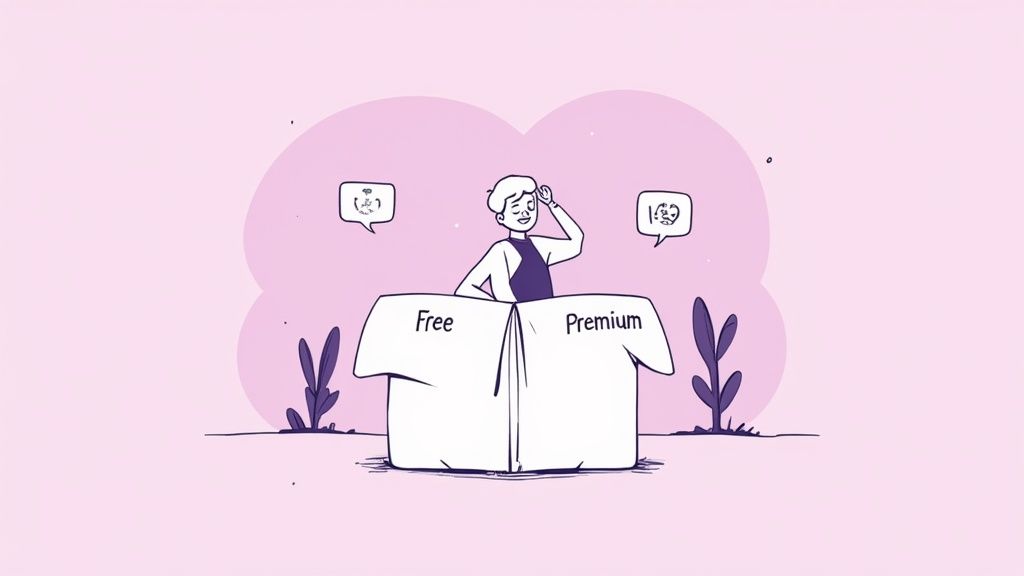
Freemium pricing offers a basic version of your service for free to convert a percentage of users into paying customers. The idea is to lower the barrier to entry and attract a wide audience. It demonstrates enough value that customers are willing to pay for more advanced features.
While common in software, this can be adapted for local services. Imagine an HVAC contractor in Monterey offering a free "DIY filter change reminder service" via an app. The app also offers a premium subscription for professional tune-ups, creating a direct funnel for paid jobs.
When to Use Freemium Pricing
This model works best when you can offer a valuable, low-cost digital service that complements your hands-on work. It’s ideal for building a large customer database and establishing your brand as a helpful authority in Monterey County. It is effective for services with a recurring need, like pest control or HVAC maintenance.
How to Implement Freemium Pricing
A successful freemium strategy needs a clear distinction between free and paid offerings. The free version must be useful on its own.
- Define Your Free Tier: Identify a simple but genuine problem you can solve for free. This could be a basic home maintenance checklist app or a water usage calculator for homeowners in Salinas.
- Create Compelling Upgrades: The premium features must solve a more significant pain point. This could be direct access to a master plumber for video consultations or priority booking.
- Focus on Conversion: Use the free tool to showcase your expertise. Track engaged users and target them with special upgrade offers.
4. Usage-Based Pricing (Pay-Per-Use)
Usage-based pricing is a dynamic strategy where the customer pays based on their actual consumption of your service. Instead of a flat fee, the cost is tied directly to how much they use. This offers a transparent and flexible model.
For a service business in Monterey County, this could mean billing based on tangible metrics. For example, a landscape maintenance company in Salinas might bill a commercial client based on gallons of water used for irrigation. This way, the client only pays for exactly what they get.
When to Use Usage-Based Pricing
This model is ideal for services with variable consumption levels. It works well for preventative maintenance or commercial cleaning. A pest control service in Watsonville could charge a restaurant based on the number of traps checked, which might vary by season.
How to Implement Usage-Based Pricing
Successful implementation hinges on accurate tracking and clear communication.
- Establish Clear Metrics: Define what "usage" means. It could be hours of labor, gallons of water, or square footage serviced.
- Implement Accurate Tracking: Use software or a meticulous manual system to log usage data for each client.
- Provide Transparent Reporting: Your invoices should clearly break down the usage for the billing period. This transparency is key to making the model work.
5. Tiered Pricing
Tiered pricing is one of the most popular service pricing strategies because it offers customers choice and control. This model involves creating several service packages at different price points. It allows you to cater to different customer segments, from budget-conscious homeowners to those wanting a premium solution.
For an HVAC contractor in Santa Cruz, this could mean offering a "Basic Tune-Up," a "Comprehensive Maintenance Plan," and a "Premium Comfort Package." This empowers the customer to choose the level of service that fits their budget and goals.
When to Use Tiered Pricing
This strategy works exceptionally well for services that can be scaled up or down, like maintenance or installations. It's ideal when you serve a diverse customer base in Monterey County. A roofer in Hollister could offer different tiers for a roof replacement based on shingle quality and warranty length.
How to Implement Tiered Pricing
Creating effective tiers requires a strategic balance of features and perceived value.
- Define Your Tiers Clearly: Start with your core service as the base package. Then, add distinct, valuable features to create "Better" and "Best" options.
- Use Strategic Naming: Name your tiers to reflect their value, such as "Bronze, Silver, Gold." This helps customers quickly understand the hierarchy.
- Leverage Anchor Pricing: Price your premium tier high to make the middle tier seem like the best value. Bundling your tiers with effective contractor lead generation services can attract the right type of customer for each package.
6. Dynamic Pricing
Dynamic pricing is a flexible approach where prices change in real-time based on current conditions. This model responds to demand, time of day, or urgency. Instead of a one-size-fits-all price, you optimize it for the specific situation.
An HVAC technician in Gilroy might charge a premium for an emergency AC repair call during a heatwave. The price reflects the immediate value and scarcity of your service at that moment.
When to Use Dynamic Pricing
This strategy is ideal for services with fluctuating demand or for businesses that offer emergency appointments. It works well when external factors, like weather, heavily influence a customer's need. If a winter storm is forecast for Monterey County, a roofer could use dynamic pricing for last-minute leak inspections.
How to Implement Dynamic Pricing
This model requires clear rules, transparent communication, and the right data to inform your adjustments.
- Define Your Triggers: Establish what factors will cause prices to change. This could include time of day, seasonal demand, or emergency status.
- Be Transparent: Clearly state on your website and during booking that prices vary for emergency or peak-season services. This builds trust.
- Use Data to Set Boundaries: Analyze past job data to identify peak demand periods and determine fair price limits. You can discover how marketing analytics and reporting impact success on core6.marketing to better understand how to leverage your data.
7. Penetration Pricing
Penetration pricing is an aggressive strategy for rapid market entry. It involves setting a low initial price to attract customers away from competitors. The primary goal is to establish a strong foothold and build brand recognition.
A new business trying to break into the competitive Santa Cruz County market could offer a significantly discounted service for the first season. Once you establish a reputation, you can gradually adjust your prices to more profitable levels.
When to Use Penetration Pricing
This strategy is most effective when launching a new business or entering a new service area with strong local competition. It works well in price-sensitive markets. A new electrician in Salinas could use it to win initial contracts.
How to Implement Penetration Pricing
This model requires careful planning to avoid being seen as the "cheap" option and to ensure a transition to profitability.
- Define Your Timeline: Establish a limited timeframe for your introductory offer. This creates urgency and manages expectations.
- Focus on Customer Lifetime Value: The goal is to acquire customers you can retain for years. Deliver an exceptional service experience that builds loyalty.
- Communicate the "Why": Frame it as an introductory offer to welcome new clients, not as your standard rate. This prevents devaluing your service.
8. Bundle Pricing
Bundle pricing is an effective strategy for increasing the average value of each job. It involves combining several services into a single package offered at a discounted price. It shifts the customer's focus from individual tasks to the comprehensive value of a complete solution.
A business in Santa Cruz County could offer a "Seasonal HVAC Tune-Up Package" that bundles a furnace inspection, A/C cleaning, and filter replacement. The homeowner gets an all-in-one solution, and you secure more work from a single visit.
When to Use Bundle Pricing
This strategy works best when you offer multiple, complementary services. It is ideal for preventative maintenance or seasonal preparations. An electrician in Salinas could bundle the installation of an EV charger with a whole-home surge protector.
How to Implement Bundle Pricing
Successful bundle pricing hinges on creating packages that offer genuine, easily understood value.
- Identify Complementary Services: Look at your most frequently requested services. An outdoor lighting installation in Monterey could be bundled with a smart timer setup.
- Price for Perceived Value: The bundled price must be noticeably lower than the sum of the individual services. Clearly show the "à la carte" prices versus the "package deal" to highlight the savings.
- Market Your Bundles Clearly: Promoting these bundles is key; you can discover more marketing strategies for service businesses on core6.marketing to see how bundling fits into a larger campaign.
Service Pricing Strategies Comparison
| Pricing Strategy | Implementation Complexity ???? | Resource Requirements ⚡ | Expected Outcomes ???? | Ideal Use Cases ???? | Key Advantages ⭐ |
|---|---|---|---|---|---|
| Value-Based Pricing | High – requires deep customer insights and market research | High – intensive research and marketing | Maximizes profit margins, aligns price with perceived customer value | Customized services, B2B consulting, high-value offerings | Premium pricing, strong customer relationships |
| Subscription Pricing | Medium – requires recurring billing systems and customer retention efforts | Medium to High – billing and analytics infrastructure | Predictable revenue, higher lifetime value, stable cash flow | SaaS, media streaming, ongoing service delivery | Stable income, customer loyalty, scalable model |
| Freemium Pricing | Medium – feature differentiation and conversion funnel management | Medium – supporting free users without direct revenue | Large user base, gradual conversion to paid users | Digital products, software platforms, apps | Low entry barrier, viral growth, user data |
| Usage-Based Pricing | High – requires accurate real-time usage tracking and complex billing | High – metering systems and analytics | Fair pricing aligned with consumption, scalable revenue | Cloud services, utilities, API-driven platforms | Flexible pricing, appeals to variable usage |
| Tiered Pricing | Medium – requires clear tier design and feature allocation | Medium – marketing and sales alignment | Captures multiple segments, upselling opportunities | SaaS, software products, service packages | Segmented pricing, simplifies choice, maximizes revenue |
| Dynamic Pricing | Very High – needs sophisticated algorithms and real-time market data | Very High – advanced analytics and automation systems | Maximizes revenue through price optimization | E-commerce, travel, on-demand services | Revenue maximization, market responsiveness |
| Penetration Pricing | Low to Medium – straightforward initial low pricing with planned increases | Medium – focus on customer acquisition | Rapid market share growth, initial low profits | New market entrants, disruptive products | Fast market entry, competitor deterrence |
| Bundle Pricing | Medium – designing complementary packages and pricing optimally | Medium – managing product/service combinations | Increased average revenue, higher customer retention | Telecom, software suites, consulting services | Higher revenue per customer, reduces decision fatigue |
Choosing the Right Pricing Strategy for Your Monterey Bay Business
Navigating service pricing strategies can feel overwhelming, but the right approach can transform your business. We've explored eight powerful models, from the customer-centric focus of Value-Based Pricing to the recurring revenue of Subscription Pricing. There is no one-size-fits-all solution for a business in our region.
The ideal structure for a roofer in Santa Cruz will look different from that of a plumber in Salinas. Your pricing is a powerful communication tool. It tells customers about your quality, confidence, and the value you deliver.
From Theory to Action: Your Next Steps
Understanding these strategies is only half the battle. Real growth comes from implementation and testing.
Here are actionable steps you can take this week:
- Audit Your Current Model: Which strategy are you using now? Are you leaving money on the table by not capturing the full value of your expertise?
- Survey Your Customers: Ask past clients what they valued most. Use this feedback to build a foundation for a value-based model.
- Model a Tiered Offer: Take a common service and create three distinct packages: "Good," "Better," and "Best."
- Explore a Subscription: Could you offer an annual maintenance plan? This creates predictable revenue that smooths out seasonal cash flow dips. To see how other businesses implement their strategies, you can explore different pricing models and strategies to gather ideas.
The Power of Strategic Pricing
Mastering these service pricing strategies is about taking control of your financial destiny. It’s about building a brand that competes on value, not just price. The most successful service businesses in the Monterey Bay area understand their worth and price their services accordingly.
By Phil Fisk, CEO, Core6 Marketing
Phil Fisk is a digital marketing expert dedicated to helping local service businesses in the Monterey Bay Area increase their online visibility and generate qualified leads. He specializes in practical, ROI-focused strategies that drive real growth for small and mid-sized companies.
Pricing is a core part of your marketing and business strategy. If you're ready to align your prices with your value and attract more high-quality leads, the team at Core6 Marketing can help. We build the digital foundation that showcases your expertise and ensures the right customers find you.
Contact Us for a Strategy Session
- Phone: 831-789-9230
- Email: [email protected]
- Address: 1628 N. Main St #263, Salinas, CA 93906
Social Caption: Choosing the right pricing strategy is key for any Monterey Bay service business. From value-based to subscription models, find the right fit to boost your profitability and win more customers. #ServicePricing #MontereyBay #LocalBusiness #MarketingTips