
Welcome to the new reality of local digital marketing. If you're a business owner in the Monterey Bay Area, you're used to working hard. But what if you could work smarter? This guide explains how to use AI for SEO—it isn't just a tech trend; it's a practical way to automate keyword discovery, personalize your content, and analyze data faster than any human ever could.
This means your business, whether you're in the ag-tech heartland of Salinas or serving the coastal communities of Santa Cruz, can finally figure out exactly what local customers are searching for and create content that speaks directly to them—almost instantly.
How to Use AI for SEO in the Monterey Bay Area

Artificial Intelligence (AI) isn't here to replace your marketing; it's here to supercharge it. For a retail shop in Carmel-by-the-Sea or a service business in Salinas, this gives you a serious competitive edge. It helps you understand your local customers on a deeper level, find those hyper-local search terms that bring in qualified leads, and ultimately boost your return on investment (ROI).
Think of AI as your tireless marketing assistant. It can sift through mountains of data in seconds to find patterns and opportunities you would absolutely miss on your own. It’s especially good at a few key tasks that are critical for businesses in Monterey County and the surrounding region.
- Keyword Discovery: AI uncovers the exact phrases people in your service area are typing into Google, like “emergency plumber in Hollister” or “digital marketing for Santa Cruz retailers.”
- Content Generation: It can help you draft blog posts, service pages, and social media updates that are already optimized for those keywords, saving you hours of writing time.
- Data Analysis: AI can track your website's performance, see what your competitors are doing, and give you clear reports on what’s working and what’s not.
AI helps you move from guessing what customers want to knowing what they need. It provides the data-driven insights to create a marketing strategy that truly connects with your audience in the tri-county area.
The goal isn't to let a robot run your business. It’s about using these tools to handle the repetitive, data-heavy tasks. This frees you up to focus on what you do best: running your business and serving our community.
Discover Untapped Local Keywords with AI
Finding the right keywords is the bedrock of any solid SEO strategy. You have to move beyond generic terms and dig into what your local customers are actually searching for. This is where you can learn how to use AI for SEO to get a serious leg up on the competition.
Instead of guessing, AI tools can comb through massive amounts of search data to uncover valuable, long-tail local phrases. These are the specific, high-intent questions that real customers type into Google, like “emergency roof repair in Watsonville” or “best HVAC installation for older homes in Pacific Grove.” Targeting these phrases connects you directly with customers ready to make a decision.
Brainstorming Local Keywords with AI Prompts
The real magic of AI is all in how you ask the questions—your prompts. You can feed it details about your business, the towns you serve, and your ideal customer, and it will generate a targeted list of keywords. This process often uncovers opportunities your competitors in a place like Salinas are completely missing.
Here are a few example prompts you can easily adapt for your own business:
- "I am a residential plumber based in Monterey, California. My ideal customers are homeowners across Monterey County. Generate a list of 50 long-tail keywords related to leak detection, drain cleaning, and water heater repair."
- "Act as a homeowner in Santa Cruz whose furnace just died. What exact search terms would you use to find a reliable and fast HVAC repair service?"
- "List 10 question-based keywords a homeowner in Gilroy might ask Google before hiring an electrician for a home remodel. Focus on keywords that show purchase intent."
Key Takeaway: Shift from broad, highly competitive keywords to specific, local phrases. A search for "plumber" is someone browsing; a search for "24-hour emergency plumber in Seaside" is a cry for help you can answer.
Analyzing Competitor Keywords
AI doesn’t just help you find your own keywords; it can also give you a peek into what’s working for others. By analyzing the websites of competing businesses in Santa Cruz County, AI can pinpoint the exact keywords they're ranking for. This kind of intelligence reveals gaps in their strategy that you can immediately exploit.
We dive deeper into these techniques in our guide on AI search optimization to prepare client websites. Getting this insight is crucial for building a strategy that doesn’t just compete but starts to dominate your local market.
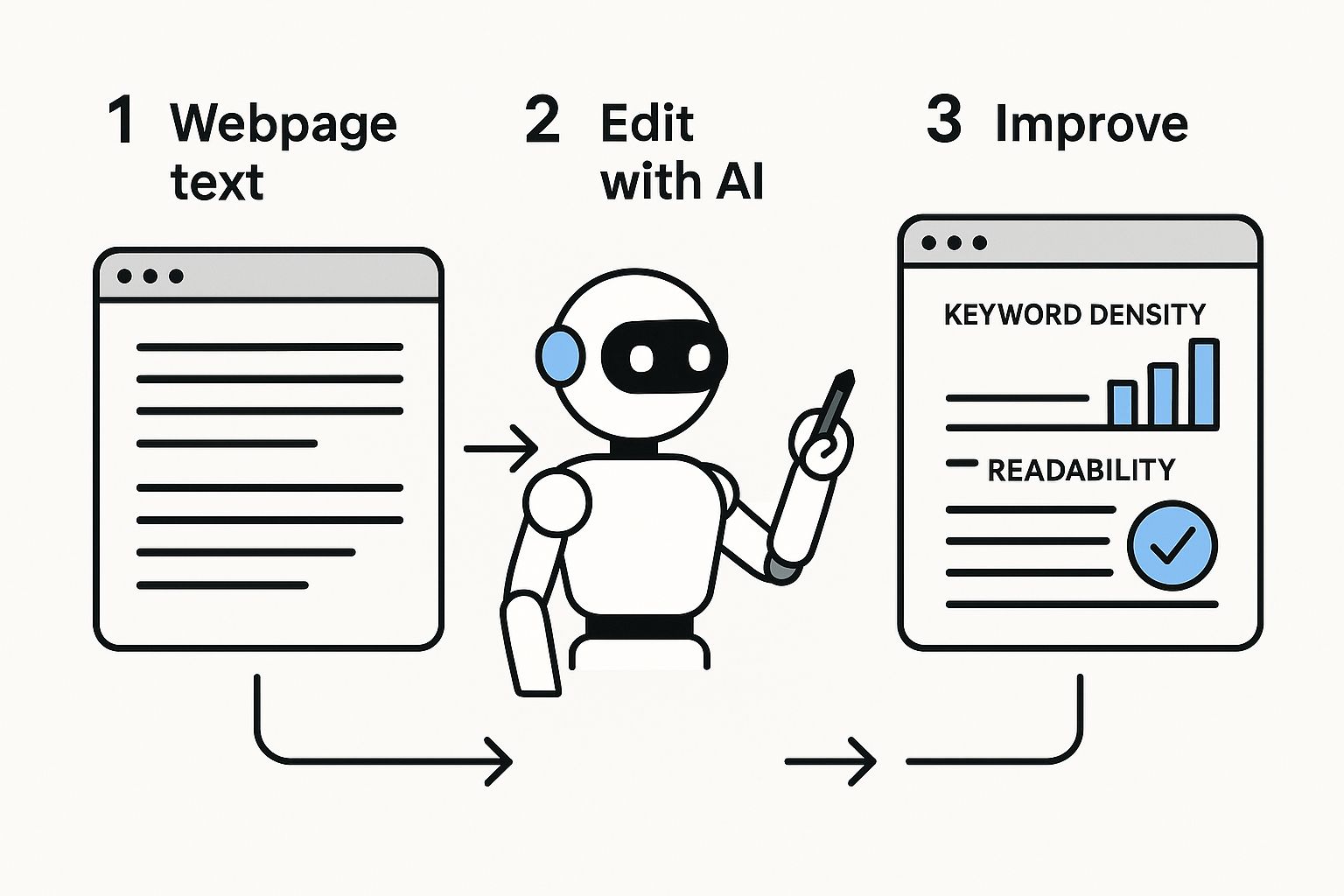
Successful SEO is a balancing act. It’s not about just stuffing keywords everywhere. It's about weaving them naturally into high-quality, readable content that both search engines and human readers appreciate.
Create Hyper-Local Content AI and Customers Will Love

Once you’ve got your local keywords, it’s time to create content that speaks to your community. This is where you shift from just using AI to partnering with it. The mission is to produce high-quality blog posts and service pages that feel authentic to a local reader, not churned out by a robot.
Think about what makes our region unique. A blog post for a roofer in Gilroy should talk about protecting a home from intense summer heat. An electrician in Monterey might write about the challenges of updating wiring in historic homes. This local flavor is something the big, faceless chains can't replicate.
AI is fantastic for getting that first draft on paper quickly, but it knows nothing about your on-the-ground experience. Your real-world expertise as a business owner in Monterey County is your most powerful tool.
Using AI as a Creative Assistant
Instead of telling an AI to "write a blog post about plumbing," you'll get far better results by treating it like a smart assistant. You guide it with specific instructions and real, local context. This back-and-forth approach turns a generic piece into something optimized for search and genuinely helpful.
Here’s a simple workflow for a locally-focused service page:
- Generate a Hyper-Local Outline: Start with a specific prompt. For example: "Create an outline for a service page on 'tankless water heater installation' targeting homeowners in Santa Cruz. Include sections on local water hardness, coastal climate energy savings, and city permit requirements."
- Draft Section by Section: Have the AI write one section at a time. This gives you room to inject your own expertise, like stories about common issues in older Pacific Grove homes or challenges in the hilly areas of Santa Cruz County.
- Optimize and Humanize: With a full draft, it's time to edit. Read it out loud. Does it sound like you? Infuse your brand’s voice, double-check facts, and weave in local client testimonials. This is the most important step.
Your expertise is what makes content valuable. AI provides the structure; you provide the soul. This human-in-the-loop process is key to creating content that both Google and your customers will trust.
Evolving for New Search Experiences
The way people find information is changing. AI is shaking up the search world, and more people are getting answers directly from AI-powered platforms. In fact, some sources show that up to 31% of searches by younger demographics now happen on tools like ChatGPT, a massive shift from traditional search engines. You can find more details in these AI SEO statistics on seo.com.
This means your content needs to be ready for what's next. By creating clear, helpful, and locally-focused content, you're not just playing today's game—you're getting set for tomorrow's. Dive into the fundamentals with our introduction to AI for local SEO to get a head start.
How to Win Visibility in Google’s AI Overviews
You've probably noticed it. You ask Google a question and get a full, direct answer at the top. That's Google's AI Overview, and it's shifting the SEO playbook for businesses right here in the Monterey Bay Area.
This new reality can feel scary. If Google is just handing out answers, why would anyone click to your website? It's a fair question. Some data shows website clicks falling as AI serves up direct answers. You can get more insights on these evolving AI SEO trends from Mike Khorev.
But here's the twist: for many businesses, conversions are actually going up. The traffic that does make it through is incredibly high-intent. Your goal isn't just about getting a click anymore. It's about being the answer. You want your Hollister business to be the source Google's AI trusts and features.
Fine-Tuning Your Content Strategy
So, how do you show up in these AI summaries? It all comes down to making your content as clear, direct, and authoritative as possible. AI is built to find the most trustworthy, straightforward answer.
Here's how to adjust your strategy:
- Answer Questions Directly: Structure your content with headings that ask a real question (e.g., "What Are the Signs of a Failing Water Heater?") and then give a direct answer in the first paragraph.
- Use Structured Data: This is a big one. Implement Schema markup, a type of code that helps search engines understand the context of your content—like your business hours, service areas, and reviews.
- Build Authority and Trust: Consistently publish genuinely helpful content that solves problems for homeowners in San Benito County. Link to credible sources and showcase your expertise with real case studies.
Every piece of content you create should aim to be the definitive local answer for a specific problem. When you achieve that, both Google's AI and your future customers will see you as the go-to expert.
Your Google Business Profile is more important than ever. All that information—services, reviews, photos, Q&A—is prime real estate for AI to pull from. For a deeper dive, check out our guide on how to rank higher in Google Maps, since many of the same principles feed into AI visibility.
Your Simple AI Action Plan
Alright, time to roll up our sleeves. This isn't about becoming an SEO wizard overnight. Instead, think of it as taking small, smart steps to get your business seen across the tri-county region. This is exactly how to use AI for SEO to start generating more high-quality leads.
Your AI Checklist
You can get started on this today. By focusing on these key areas, you'll be building a stronger foundation, whether you’re based in Marina or anywhere else in Monterey County.
Here's what to do:
- Dig for Local Keywords: Use an AI tool to brainstorm hyper-local keywords. A great prompt is: "List 20 search terms a homeowner in Salinas would use to find an emergency electrician."
- Outline Your Content: Have AI create a detailed outline for a new blog post or service page. This simple step ensures your content is structured logically for customers and search engines.
- Draft, Then Perfect: Let the AI handle the first draft. Then, it's your turn to inject your human expertise. Add your own stories, mention specific local neighborhoods, and tweak the tone until it sounds exactly like you.
The real magic of AI is the efficiency it brings. It does the heavy lifting—analyzing data and getting words on the page—which frees you up to focus on strategy and add the local flavor only a real person can.
This balanced approach works wonders. For more tailored ideas, check out our guides on local SEO for contractors or AI-driven SEO for landscapers.
Did You Know?
The Monterey Bay is home to one of the world's deepest submarine canyons, reaching depths over two miles. This unique underwater geography fuels our rich marine ecosystem and stunning coastal views, making it a truly special place to live and work.
Still Have Questions About AI for SEO?
As you start digging into how AI can work for your business, it's normal to have questions. Our goal is to cut through the noise and give you clear, straightforward answers. Here are a few common questions we hear from business owners in the tri-county area.
Can AI completely replace my marketing person?
Nope. AI is an incredible assistant, but it can't replace the strategic thinking, local market knowledge, and creative gut-checks a human expert brings. Think of AI as your co-pilot; you still need an experienced pilot to fly the plane.
What’s the biggest risk of using AI for local SEO?
The number one risk is getting lazy and relying on it too much. This leads to generic, bland, and sometimes incorrect content. Without a real person reviewing the output, AI will miss the local flavor needed to connect with customers in a place like Santa Cruz. Always fact-check and edit anything an AI generates.
How much do these AI SEO tools cost?
The price really runs the gamut. Some platforms have free plans that are fantastic for getting started. More advanced tools can cost anywhere from $50 to several hundred dollars a month. Our advice? Start free to get a feel for it before committing to a paid plan.
I’m not a tech expert. How do I even start?
Keep it simple. Pick one small, specific task, like using an AI tool to brainstorm blog post ideas for your Salinas-based business. Most of these tools are built for regular business owners, not computer scientists, so they're surprisingly easy to use.
Ready to see how a smart, AI-enhanced SEO strategy can drive real, measurable results for your business? Contact Core6 Marketing for a free, no-obligation consultation.
- Phone: 831-789-9320
- Email: [email protected]
- Visit Us: https://core6.marketing
By Phil Fisk, CEO, Core6 Marketing
Phil Fisk is the founder of Core6 Marketing, a specialized digital marketing agency in Salinas, CA, dedicated to helping local businesses grow. With over a decade of experience, Phil focuses on data-driven SEO and lead generation strategies that deliver tangible ROI for businesses throughout the Monterey Bay Area.
Core6 Marketing
1628 N. Main St #263, Salinas, CA 93906
831-789-9320
[email protected]