
For any business owner, from ag-tech innovators in Salinas to the bustling storefronts of Santa Cruz, one question always comes up: "Is my marketing actually working?" Answering this question is crucial for measuring marketing effectiveness and turning your marketing dollars into real business results—like qualified leads and signed contracts, not just vanity metrics. It’s the clearest, most reliable path to growing your business in our competitive Monterey Bay market.
This guide is designed to be actionable and immediately helpful for small- to mid-sized business owners in Monterey County, Santa Cruz County, and San Benito County. We'll show you how to connect your marketing spend to tangible outcomes.
Why Measuring Your Marketing Is Non-Negotiable
In a region with an economy as diverse as ours, stretching from tourism in Monterey to agriculture in San Benito County, every single marketing dollar has to pull its weight.
Just running ads or posting on social media without tracking what happens next is like trying to navigate Monterey Bay in a thick fog without a compass. Sure, you’re moving, but you have no idea if you’re heading toward your destination or straight into the rocks.
When you measure effectively, marketing stops being a mysterious expense and becomes a predictable engine for growth. It’s the difference between guessing what works and knowing what works.
The Real Cost of Flying Blind
When you don’t measure your marketing, you aren't just wasting money on campaigns that flop; you're actively missing out on huge opportunities. You could be ignoring a tactic that's quietly bringing in your best, most profitable customers.
Without data, you’re forced to make critical business decisions based on gut feelings. Here’s what’s really at stake:
- Wasted Budget: Pouring cash into channels that don’t deliver qualified leads or sales.
- Stagnant Growth: Failing to spot and scale the marketing activities that actually move the needle.
- Missed Opportunities: Overlooking valuable customer segments or high-performing keywords that your competitors are snapping up.
- Lack of Accountability: Being unable to prove the value of your marketing efforts to your team or even yourself.
The Foundation of Smart Decisions
At the end of the day, measuring marketing effectiveness gives you the clarity to make confident, data-driven decisions. It’s what allows a Gilroy-based manufacturer to see exactly which trade publication ad generated the most valuable inquiries. It’s how a small Carmel-by-the-Sea boutique can finally understand how its Instagram posts translate into actual foot traffic.
This guide will cut through the noise. We’ll walk you through core concepts, from Return on Investment (ROI) to Customer Acquisition Cost (CAC), and show you how to apply them directly to your business. Whether you’re looking for a top-tier SEO agency in Salinas or a partner for digital marketing for Santa Cruz retailers, mastering measurement is the first real step toward building a stronger, more profitable local business.
Setting Clear Goals For Your Local Business
Before you can measure your marketing effectiveness, you have to know what winning looks like. A tourism company in Monterey has completely different goals than a B2B service provider in Hollister. Vague wishes like "more customers" are a recipe for a wasted marketing budget.
To get real, tangible results, your goals need to be sharp and focused. This is where the SMART framework comes in. It’s a tried-and-true method for turning fuzzy ideas into concrete targets you can actually hit.
From Vague Ideas to SMART Objectives
The SMART framework forces your goals to be Specific, Measurable, Achievable, Relevant, and Time-bound. It’s the difference between saying, "I want more leads," and having a real plan of attack.
Let's break this down for a local business right here in Monterey County:
- Specific: Don't just say "get more website traffic." A specific goal is "increase organic traffic to our plumbing services page from homeowners in Salinas and surrounding areas."
- Measurable: How will you track it? A measurable goal is, "Generate 15 qualified leads per month through our Google Ads campaign."
- Achievable: Your goals should stretch you, not break you. If you get 5 leads a month now, aiming for 10 is a realistic, achievable step forward.
- Relevant: Does this goal help your business grow? If you want to expand your high-margin roof repair division, your goal should be, "Increase lead volume for 'emergency roof repair in Santa Cruz' by 25%."
- Time-bound: Every goal needs a deadline. "Increase online bookings for HVAC tune-ups by 20% over the next six months (Q3-Q4)" creates urgency and a clear finish line.
By setting SMART goals, your marketing becomes a deliberate plan designed to produce a specific, valuable outcome for your business.
Local Examples of Strong Marketing Goals
When you apply this framework, your goals become real and connected to our local economy. The targets for a Watsonville farm will look very different from a law firm in Pacific Grove, but the underlying structure is identical.
Think about these real-world examples:
- An Electrical Contractor in Gilroy: "Increase signed contracts from our website’s ‘Request an Estimate’ form by 30% within the next quarter by improving our local SEO rankings."
- A Remodeler in Carmel-by-the-Sea: "Generate 10 high-value kitchen remodeling consultations per month from our social media ad campaigns within 90 days."
Each goal is precise, trackable, and directly impacts revenue. Once you know what you're trying to accomplish, understanding the role of marketing analytics and reporting becomes crystal clear. Analytics provides the data to prove whether you're hitting these targets.
Core Metrics Every Monterey County Business Should Track
Okay, you’ve got your goals locked in. Now it’s time to stop making assumptions and start measuring marketing effectiveness with hard numbers. For any business in Monterey County, picking the right Key Performance Indicators (KPIs) means focusing on metrics that actually move the needle.
Forget about getting bogged down in confusing acronyms. For most local service businesses, success comes down to a handful of essential metrics. These are the numbers that tell you the real story, from the agricultural heart of Salinas to the coastal communities of Santa Cruz.
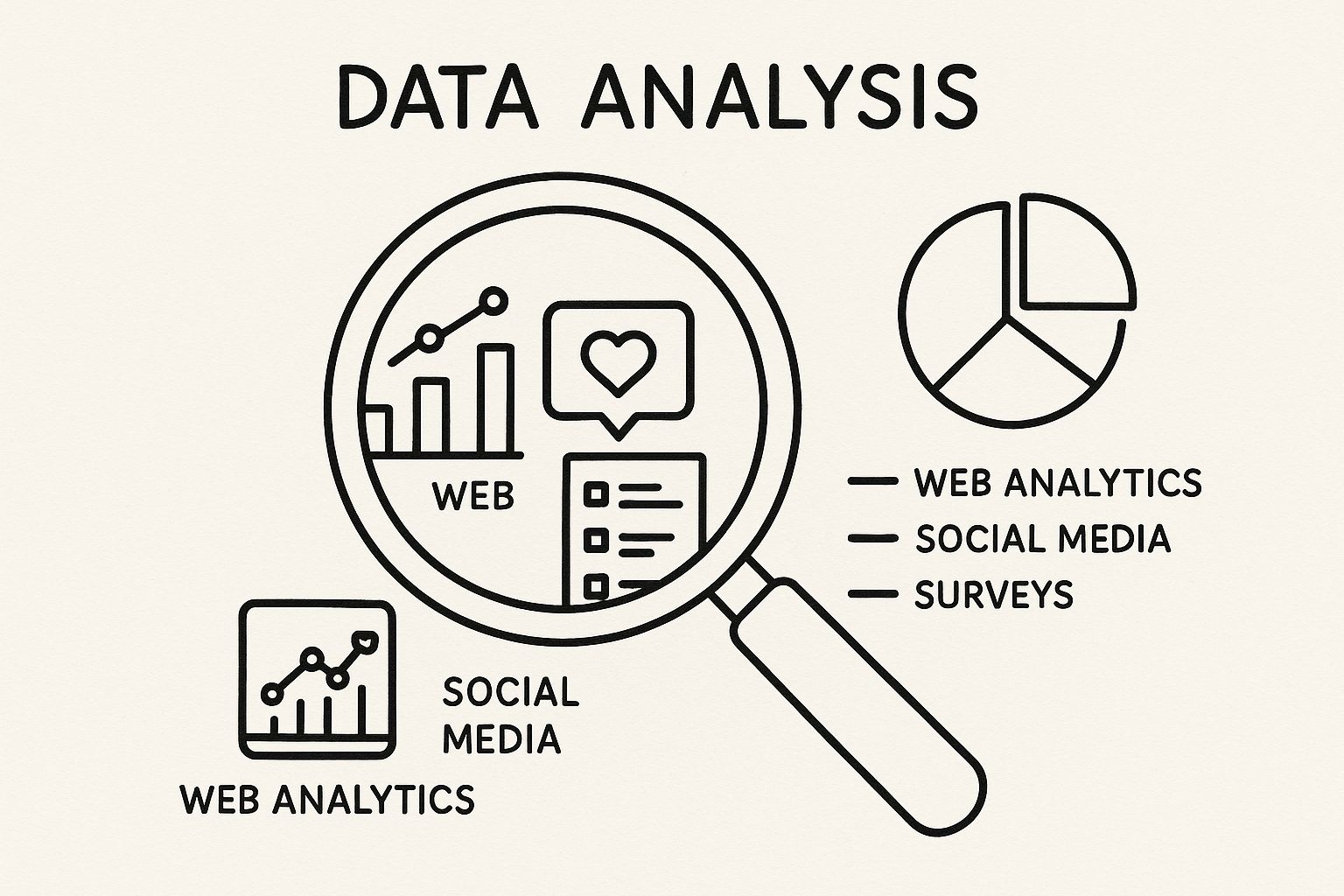
Solid measurement isn’t about looking at one thing in isolation. It’s about pulling insights from multiple sources to get the full picture.
Essential Metrics That Drive Growth
Let’s zero in on the KPIs that truly matter. These are practical tools to help you make smarter decisions.
-
Customer Acquisition Cost (CAC): This is your total marketing and sales cost divided by the number of new customers you landed. Let's say you spent $2,000 on Google Ads last month and got 10 new clients. Your CAC is $200. A high CAC might be a sign to tighten up your ad targeting.
-
Customer Lifetime Value (CLV): This is the total revenue you can expect from a single customer over time. Understanding your CLV is huge because it helps justify your marketing spend. A high CLV can make a higher CAC perfectly acceptable.
-
Conversion Rate: This is the percentage of people who take an action you want them to take, like filling out a contact form or calling your shop. If 100 people visit your website and 5 of them call you, your conversion rate is 5%.
These metrics are the bedrock of any smart measurement plan. Learning more about measuring your marketing ROI is a great next step to connect these numbers to real profit.
Why You Need a Consistent Framework
Tracking these numbers isn’t a one-off task; it’s an ongoing discipline. When you adopt a standardized KPI framework, it gets everyone on your team on the same page.
For a local business, this means having a clear, repeatable way to see what's working. It allows an SEO agency in Salinas to show a client exactly how improvements in organic search are lowering their overall Customer Acquisition Cost.
Of course, tracking goes beyond just your ad campaigns. Your organic search performance is a massive piece of the puzzle. If you want to dig deeper, check out our guide on how to track your SEO rankings.
Did You Know?
Monterey County's agriculture industry has an annual production value of over $4 billion, according to the Agricultural Commissioner's latest crop report. This robust ag-tech sector creates unique marketing opportunities for B2B service providers in our region.
Modern Tools for More Accurate Measurement
Trying to manually track every click and call is a recipe for a massive headache. The good news? The tools for measuring marketing effectiveness have become incredibly powerful and accessible, even for small businesses in our coastal economy.
We no longer have to rely on the old, simplistic "last-click" model. Modern measurement lets us see how all our marketing efforts truly work together.
The Rise of Holistic Measurement Models
Two concepts have become essential: Media Mix Modeling (MMM) and incrementality. Don't let the technical names throw you off; the ideas are straightforward.
-
Media Mix Modeling (MMM): This is a big-picture analysis that looks at all your marketing—online and offline—to see how each piece contributes to sales. For a retailer in Marina, an MMM could show how radio ads, Google Ads, and local event sponsorships all drive revenue.
-
Incrementality Measurement: This is about figuring out if a specific marketing touchpoint actually caused a conversion that wouldn't have happened otherwise. It answers the critical question: "Did that Facebook ad really lead to the sale?"
These approaches became mission-critical after recent privacy updates made it much harder to track individual users.
Embracing New Tools and Technologies
This shift toward the whole picture is changing how we do business. Over 61% of marketers are planning to beef up their measurement by integrating MMM. You can learn more by checking out the research on the future of marketing measurement.
What’s really exciting is that these advanced techniques are no longer just for giant corporations. Open-source tools have put this power directly into the hands of local business owners from San Benito County to the Monterey coast.
Two of the biggest game-changers are:
- Meridian by Google: An open-source MMM designed to help marketers measure campaign ROI without user-level tracking.
- Robyn by Meta: Another open-source MMM tool that helps businesses understand marketing effectiveness across all channels.
Here’s a snapshot from Google's Meridian documentation. It shows how the tool visualizes which channels are pulling their weight over time.
A chart like this lets you see, at a glance, which channels are driving real impact. It moves the conversation from "How many clicks did we get?" to "How much revenue did our search ads generate?"
All this data needs a home: your dashboard. A well-built marketing performance dashboard brings all your key metrics together, making it simple to spot trends and make smart decisions.
Turning Data Into Actionable Growth Strategies

All the reports in the world are useless if the data just sits there. The real power in measuring marketing effectiveness comes from turning numbers into smart decisions that fuel your growth.
Imagine your analytics show a campaign targeting digital marketing for Santa Cruz retailers gets tons of traffic, but very few calls. That’s not a failure; it’s a critical clue. This data tells you exactly where to focus your energy next.
A Framework For Data-Driven Decisions
Thinking like a top-tier marketer means creating a simple, repeatable process for looking at data and making adjustments. For a business owner in Monterey County, this disciplined approach provides a huge advantage.
This process boils down to a few key activities:
- A/B Testing: Always be testing different versions of your ad copy, headlines, and images.
- Budget Reallocation: Be ready to shift marketing dollars away from underperforming channels.
- Audience Refining: Use performance data to sharpen your targeting on specific demographics and locations.
The goal isn’t just to collect data, but to ask the right questions of it: “What should we start, stop, or continue doing based on this number?”
Data-Driven Action Plan
A simple framework for translating marketing data into growth-oriented actions.
| If You See This Metric… | It Could Mean… | Your Next Action Step |
|---|---|---|
| High Clicks, Low Conversions | Your ad is compelling, but your landing page isn't closing the deal. | A/B test your landing page headline, call-to-action (CTA), and form. |
| High Cost Per Lead (CPL) | Your ad spend on that platform isn't efficient. | Pause or lower the budget for that channel and reallocate funds. |
| Low Social Media Engagement | Your content isn't resonating with your audience. | Experiment with different content types (e.g., video, client testimonials). |
| High Bounce Rate on Website | Visitors are leaving your site quickly. | Run a site speed test, optimize images, and check your mobile design. |
Seeing these patterns isn't a sign of failure—it's an opportunity to get smarter. This proactive approach is fundamental to lowering your overall customer acquisition cost and maximizing your profitability.
For more specific examples, this actionable social media marketing guide is a great resource that emphasizes turning insights into real-world results.
Got Questions About Measuring Your Marketing? We've Got Answers
Even with the best plan, questions pop up. Here are some of the most common ones we hear from business owners across the Monterey Bay Area.
"How often should I look at my numbers?"
It depends on what you're looking at. You don't need to live in your analytics dashboard, but you do need a rhythm.
For fast-moving ad campaigns—like Cost Per Click (CPC)—a weekly check-in is smart. For bigger picture metrics, like your overall lead volume, a monthly review makes more sense. Then you have heavy hitters like Customer Lifetime Value (CLV), which are quarterly conversations.
"What’s the real difference between Attribution and MMM?"
It’s the difference between a close-up photo and a panoramic shot.
-
Attribution is the close-up. It tries to give credit for a conversion to a specific touchpoint, like a single ad click.
-
Marketing Mix Modeling (MMM) is the panoramic view. It’s a top-down analysis that looks at how all your marketing efforts work together over time. With new data privacy rules, MMM is becoming a go-to tool for seeing the whole picture.
"How do I measure my offline marketing?"
Tracking a print ad in a local Monterey County paper or a banner at an event seems tough, but it’s simpler than you think. The trick is to build a bridge between your offline effort and your digital tracking system.
Here are a few proven methods:
- Unique Promo Codes: Create a special code just for that ad, like "BAYVIEW10".
- Dedicated Phone Numbers: Use a call-tracking service to assign a unique phone number to your offline ad.
- Specific URLs: Create a simple landing page like YourSite.com/Gilroy.
- Just Ask! Train your team to ask every new lead, "How did you hear about us?" The insights from understanding how online reviews affect your business show just how powerful that direct customer feedback can be.
Ready to stop guessing and start knowing what drives your growth? The team at Core6 Marketing builds data-driven strategies that deliver measurable results for Monterey Bay businesses.
Schedule your free consultation today!
By Phil Fisk, CEO, Core6 Marketing
Phil is the founder and CEO of Core6 Marketing, a digital marketing agency dedicated to helping local businesses in the Monterey Bay Area achieve predictable, profitable growth. With over a decade of experience, he specializes in creating data-driven strategies that connect marketing efforts to bottom-line results.
Core6 Marketing
1628 N. Main St #263, Salinas, CA 93906
(831) 789-9320 | [email protected] | https://core6.marketing/