If you want to know how to track your SEO rankings, the answer is straightforward: you need a specialized tool to see where you stand on Google for your most important keywords. For business owners in the Monterey Bay Area, this isn't just a technical exercise—it's a critical step toward generating more local leads.
Here's a common mistake I see business owners make: they just Google their own company to check their rank. This gives you a skewed, inaccurate picture. Google knows who you are and where you are, so the results it shows are personalized. Real tracking requires unbiased data to see what potential customers in Salinas or Santa Cruz actually see.
Your Foundation for Tracking Local SEO Rankings

For any business owner in Monterey County, knowing where you stand on Google is the absolute first step toward growth. But what does that really mean? It’s not about ego; it’s about understanding your visibility where it truly matters—in the specific neighborhoods and cities you serve, from the coastline to our rich agricultural valleys.
Thinking you can just search for your company from your office computer is a trap. Google's results are heavily influenced by your search history and, most importantly, your physical location. A search for "digital marketing for Santa Cruz retailers" will pull up a completely different list of businesses than the same search done in Gilroy.
This is what we call proximity bias, and it’s the number one reason why professional rank tracking is non-negotiable for a local business.
Why SERP Features Matter for Monterey County Businesses
Your rank isn't just a single number on a list of blue links anymore. Today’s Search Engine Results Page (SERP)—which is just the page of results you see after a search—is a dynamic mix of different elements. Every single one is an opportunity for your business to get noticed.
For a local business, these are the SERP features that matter most:
- The Local Pack: This is the map with three business listings right at the top of the results. For any business in Monterey County, this is prime digital real estate. You want to be here.
- Organic Listings: These are the traditional website links that show up below the Local Pack. Strong on-page SEO is what gets you ranked here.
- Local Service Ads (LSAs): You've seen them—the "Google Guaranteed" ads at the very top of the page. These are absolutely essential for many service-based businesses today.
- "People Also Ask" Boxes: These are dropdown boxes with questions related to the search. If you create content that answers these specific questions, you can earn extra visibility.
Tracking isn't just about chasing the #1 spot. It's about owning as much real estate on the first page of Google as you possibly can, from the Local Pack to the organic results. Each placement builds trust and drastically increases the chances that a customer will click on your business.
To track your SEO effectively, you have to monitor your performance across all these different features, not just one. This approach gives you a complete, holistic view of your digital footprint and shows you exactly where to focus your energy for the biggest impact. As you'll see, the evolution of search is fundamentally shaping the future of local service businesses, making smart, comprehensive tracking more important than ever.
Essential Rank Tracking Metrics for Local Businesses
To help you get started, here's a quick overview of the key performance indicators (KPIs) you should be monitoring. This isn't an exhaustive list, but it's the foundation for understanding your local search performance.
| Metric | What It Tells You | Why It Matters for a Monterey Bay Business |
|---|---|---|
| Local Pack Rank | Your position within the top 3 map listings for a specific keyword and location. | This is the most valuable spot for local queries like "plumber in Salinas." |
| Organic Rank | Your position in the standard, non-map search results. | Shows the strength of your website's overall SEO authority and content. |
| Search Visibility % | An aggregated score showing how often you appear in search results across all tracked keywords. | A high-level view of your overall market share on Google. |
| Click-Through Rate (CTR) | The percentage of people who click on your listing after seeing it. | A low CTR might mean your title or meta description isn't compelling enough. |
| Keyword Rank by City/ZIP | Your ranking for a keyword when searched from a specific geographical point. | Essential for seeing if you're visible in Carmel and Hollister, not just one city. |
Monitoring these metrics consistently will tell you a story. You'll see what's working, what's not, and where new opportunities are emerging in the Monterey Bay market. It’s the difference between guessing and making data-driven decisions to grow your business.
Choosing The Right SEO Tracking Tools
Knowing you need to track your rankings is one thing; picking the right tool from a crowded market is a whole other challenge. The good news? You don’t need the most expensive or complicated platform to get the job done.
For a local business here in the Monterey Bay Area, the best tool is one that gives you accurate, actionable data without a huge learning curve or a hefty price tag.
Popular platforms like Semrush, Ahrefs, and SE Ranking are well-known for a reason, but they all come with different strengths and costs. The trick is to look past the flashy, enterprise-level features and focus on what actually matters for your business.
Can the tool show you how you rank for "emergency HVAC" specifically in Gilroy? Can it track your position on mobile for a customer searching in Watsonville? This kind of granular, local detail is non-negotiable.
Core Features for Local Businesses
When you’re comparing your options, these three features should be at the top of your list. They’re the foundation of any solid local rank tracking setup and directly impact your ability to make smart decisions for your business.
- Geo-Specific Tracking: The tool must let you set your tracking location down to a specific city or even a ZIP code. This is how you get past Google's proximity bias and see what customers in different parts of Monterey County are actually seeing in their search results.
- Mobile vs. Desktop Rankings: A huge chunk of your customers will find you on their phones—often while they’re out and about needing your services. Your rankings can be completely different on mobile versus desktop, so you need a tool that tracks both separately.
- SERP Feature Tracking: It’s not just about the classic blue links anymore. A good tool will show you if you’re appearing in the Local Pack (the map listings at the top), which is prime real estate for any local contractor.
Here’s a great example of what a clean, user-friendly rank tracking dashboard looks like. This one is from SE Ranking.

See how it clearly displays key metrics like average position and search visibility? This gives you a quick, at-a-glance health check of your SEO performance. That kind of clarity is exactly what a busy business owner needs.
Balancing Cost and Capability
You absolutely do not need to break the bank. Many excellent tools offer tiered pricing based on the number of keywords you want to track. For most local businesses, an entry-level plan is more than enough to get started. As you compare, it's also worth looking into the best generative search optimization tools that use AI for deeper insights, which can offer even more bang for your buck.
A simple tool that you use consistently is infinitely more valuable than a powerful, expensive one that gathers digital dust.
Your goal is to find a platform that fits your workflow and budget, making it easy to check in and monitor your local presence.
Choosing the right tool sets the stage for everything that follows. It ensures the data you gather is reliable and, most importantly, relevant to your local market. Once you have this in place, you can build a dashboard that turns raw numbers into a clear roadmap for growth. For more practical tips on boosting local visibility, check out these 5 local SEO hacks for contractors.
Setting Up Your First Rank Tracking Dashboard
Alright, you've picked your tool. Now it's time to put it to work. Don't let the setup process intimidate you; it's a straightforward process that lays the foundation for all your future insights.
Think of it as building a custom command center for your business's online visibility. The point is to ditch messy spreadsheets and stop doing random Google searches to see where you stand. A properly configured dashboard delivers consistent, unbiased data that shows exactly how your business is performing for customers across San Benito County. This setup is your ticket to making real, data-driven decisions that actually generate leads.
Adding Your Core Keywords and Locations
First things first: you need to tell the tool what to track. Start by loading in a list of your most valuable keywords—the exact phrases a potential customer would type into Google to find your services. For a local business like yours, that means getting specific.
Instead of just tracking a generic term like "plumber," you need to add variations that reflect your actual service area. For example:
- "Emergency plumber in Hollister"
- "Commercial plumbing San Benito County"
- "Trenchless sewer repair Gilroy"
Most tools will ask you to set a default geographic location for your project. Make sure you set this to your main city, like Hollister, to ensure your reports are centered on your primary market. This is an absolutely critical step if you want to know how to track SEO rankings accurately for a local business.
Pro Tip: Don't just dump your keywords in and call it a day. Organize them. Use the tags or groups feature within your tool to categorize keywords by service line (e.g., 'HVAC repair,' 'furnace installation') or by specific location. This keeps your data tidy and makes it way easier to spot performance trends for different parts of your business down the road.
This simple graphic below breaks down the basic flow of how your tracking tool will work, turning all that raw data into strategic action.
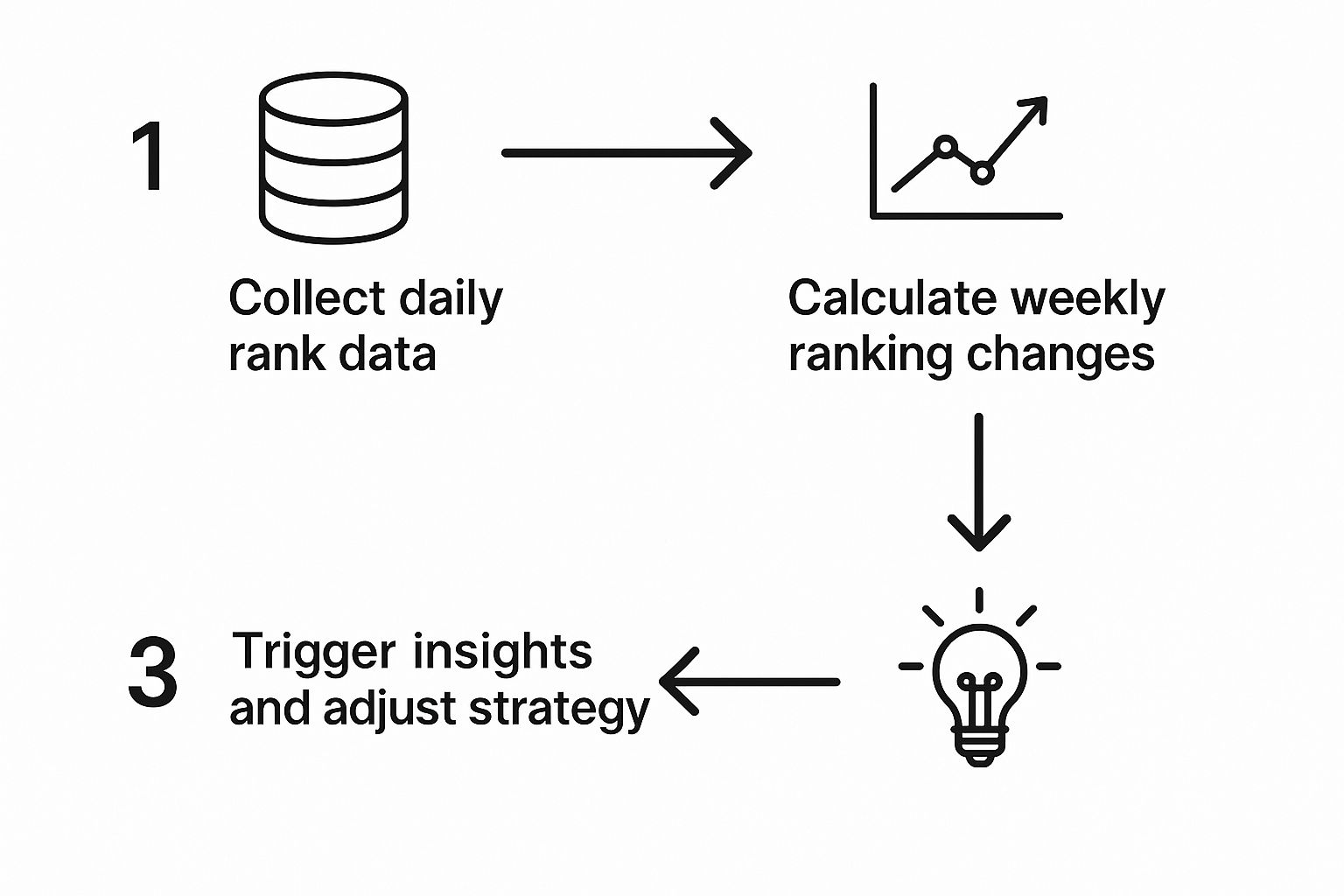
This creates a powerful feedback loop. Daily data collection directly informs your weekly strategic tweaks, which is what keeps your SEO efforts agile and effective.
Scheduling Your Reports
The last piece of the initial setup is automating your reports. Honestly, who has time to manually check rankings every day? It’s inefficient and totally unnecessary. Instead, set up your tool to email you an automated report, maybe weekly or bi-weekly.
For most business owners, a weekly email summary is the sweet spot. It gives you a consistent pulse on your performance without drowning you in data. This report should highlight any significant changes—both wins and losses—so you can stay informed and react quickly to major shifts in your visibility across the Monterey Bay Area.
With this dashboard in place, you’ve officially built the foundation for a smarter, more effective local SEO strategy.
Using Historical Data to Find SEO Opportunities

Powerful SEO isn’t about snapshots; it’s about watching the whole movie. A single ranking report is like judging the weather by looking outside for five minutes—you miss the bigger picture.
The real magic happens when you use historical data to your advantage. When you look back at your performance over several months, you start to see the stories hidden in the numbers. This is where you shift from just reacting to problems to proactively finding opportunities your competitors completely miss.
Uncovering Seasonal Trends in the Monterey Bay
Our local economy here in the Monterey Bay Area has its own unique rhythm. A roofing contractor in Santa Cruz County knows the phone will start ringing off the hook after the first big winter storm. In the same way, a high-end remodeler will see a rush of interest from homeowners in Carmel-by-the-Sea getting their properties ready for the summer season.
Your historical ranking data will tell you this exact story. By analyzing your keyword performance over the last 12-24 months, you can pinpoint:
- Seasonal Keyword Peaks: You can see exactly when searches for services like "AC repair in Salinas" start to climb. If it consistently spikes in May, you know to get your content and ads rolling in April.
- Performance Dips: Do your rankings seem to drop every fall? That’s your cue to refresh your website content or launch a seasonal promotion to fight back against the slump.
By understanding these trends, you stop getting surprised by them. You can prepare your marketing campaigns and website content before your customers even start searching, giving you a serious competitive advantage.
This is a core part of any strong digital strategy. For any local business, grasping this is a key piece of the puzzle to mastering local SEO and securing long-term success.
Connecting Website Changes to Ranking Shifts
Historical data is also your best friend for measuring what’s actually working. Did you launch a new website in March? Start a blog back in September? Looking back allows you to draw a straight line between those actions and your search visibility.
It's also a fantastic diagnostic tool. If your rankings for a key service suddenly tanked in October, you can look back and see if it lines up with a known Google algorithm update or a technical change you made on your site. Without that history, you're just guessing in the dark. The ability to look back is essential; some platforms even let you see monthly data on rankings and traffic from the moment a project was created, giving you a rich history to pull from.
The table below breaks down how you can approach this analysis for your own Monterey County business, looking at both the short-term noise and the long-term signals.
Historical SEO Data Analysis
Comparing short-term fluctuations with long-term trends to inform strategy for your Monterey County business.
| Data Point | Short-Term Analysis (Weekly/Monthly) | Long-Term Analysis (Quarterly/Yearly) |
|---|---|---|
| Rank Volatility | Monitors immediate reactions to minor site updates or competitor moves. | Identifies long-term algorithm impacts and overall strategy effectiveness. |
| New Keyword Discovery | Catches emerging search terms you can quickly target. | Reveals consistent, valuable "long-tail" keywords to build content around. |
| Local Pack Performance | Checks if you're visible for "near me" searches from day to day. | Shows if you're building true authority in specific cities like Salinas or Monterey. |
| CTR Fluctuations | Helps you test new page titles and meta descriptions for better clicks. | Indicates whether your brand recognition and trust are growing over time. |
At the end of the day, looking backward is the most effective way to plan forward. It transforms your ranking data from a simple report card into a strategic roadmap for growth.
Turning Ranking Data into an Actionable Strategy
Your rank tracking report is more than just a list of numbers; it's a strategic guide telling you what to do next. Data is only valuable if it leads to action, and for businesses in places like Pacific Grove or Marina, this is where you connect the dots between your reports and your real-world business goals.
So, what do you do when a keyword ranking drops? How do you capitalize on a sudden surge in visibility? This is all about translating those numbers into tangible tasks that boost your local authority and, more importantly, your bottom line.
Responding to Ranking Changes
Let's walk through a real-world scenario for an SEO agency in Salinas. Your rank tracking dashboard shows that your keyword "Salinas agricultural technology services" has slipped from position #4 to #11. This isn't a reason to panic. It's a signal to act.
A drop like this often means Google sees your content as less relevant or fresh than a competitor's. Your response should be direct and strategic:
- Refresh Your Content: Go to the page on your website that targets this keyword. Can you add a new case study? Maybe update some statistics or expand on the services you offer? Small tweaks can make a big difference.
- Create New Content: If your existing page is a bit thin, this is your cue to build something more substantial. A detailed article titled "The Top 5 Agricultural Technology Solutions for Salinas Valley Farms" could be exactly what Google is looking for to re-establish your authority.
- Strengthen Internal Links: Go through your other blog posts and service pages. Find natural opportunities to link back to your "Salinas agricultural technology" page. This simple step signals its importance to search engines.
Think of your rank tracker as an early warning system. A dip in rankings gives you a chance to reinforce your website's authority on a topic before you lose significant ground and valuable leads.
Capitalizing on Positive Momentum
The flip side of this is just as important. What if your rankings for "best coffee in Monterey" suddenly jump into the top three? Don't just sit back and admire the good news—double down on it.
A surge in visibility means you've caught Google's attention. Now is the perfect time to pour some fuel on the fire:
- Optimize Your Google Business Profile: Your GBP is prime real estate. Update it with fresh photos of your coffee, encourage recent customers to leave reviews, and create a new post announcing a special offer to draw people in.
- Launch a Local Promotion: Run a small, targeted social media ad campaign aimed specifically at people in Monterey. Let them know you're one of the top-ranked coffee spots in town.
- Check Your Technical Health: A high rank is great, but it's not always permanent. It's crucial to optimise your site for the Google Page Experience Update. A fast, user-friendly site helps secure those top spots for the long haul.
By actively responding to both the wins and the losses, you turn static reports into a dynamic growth strategy. For contractors, this might mean creating targeted content when a service-specific keyword rises—a topic we cover in depth in our guide to mastering SEO for home services.
Your Top SEO Questions, Answered
Even with the best tools and a clear dashboard, it's natural to have questions. For business owners in the Monterey Bay Area, knowing what to expect from your SEO efforts is half the battle. Let's tackle some of the most common questions we hear about tracking rankings and what all this data really means for your bottom line.
How Long Does It Take to See SEO Results?
This is the big one, and the only honest answer is: it depends. Generally, you can expect to see some initial movement within 3-6 months. But hitting those consistently high rankings for competitive keywords? That can easily take 6-12 months or longer.
Think of SEO less like a light switch and more like planting a garden—our local agricultural roots teach us a lot about patience and process. You have to do the work upfront before you can expect to see a real harvest.
Several factors will speed up or slow down your timeline:
- The Competition: Trying to rank for "HVAC repair in Santa Cruz" is a much bigger fight than ranking for a niche service in a smaller town.
- Your Website's History: An established site with some history and authority will see results faster than a brand-new domain starting from scratch.
- How Aggressive You Are: A comprehensive, multi-faceted SEO campaign will always get you there faster than a minimal-effort approach.
Why Are My Rankings Bouncing Around So Much?
It can be unnerving to see your keyword rankings jump from #5 one day to #8 the next, but a certain amount of fluctuation is completely normal. This volatility is just part of the living, breathing search engine ecosystem.
Minor day-to-day bounces are usually just noise. What you need to watch for are significant, sustained drops. Those could signal a bigger issue, like a recent Google algorithm update that changed the rules or a new, aggressive competitor popping up in Monterey County.
This is where historical data becomes your best friend. It helps you separate the daily jitters from a genuine trend that needs your attention. Tools are getting better at this, too. For instance, many modern APIs can now provide a detailed time-series analysis of a site's ranking history. If you want to get a sense of how powerful this can be, you can discover more about using historical data for SEO and see how it helps paint a clearer picture of long-term visibility.
What Should I Do If My Rankings Aren't Improving?
If you’ve been putting in the work for months and your rankings are stuck in neutral, it’s time for a diagnostic check. Simply continuing to do the same thing while hoping for a different outcome is a recipe for frustration.
A plateau in your rankings is a signal to re-evaluate, not to give up. It’s an opportunity to find what’s missing in your strategy.
Start by digging into these four areas:
- Is My Content Really the Best? Be honest. Does your page answer a searcher's question more thoroughly and helpfully than the pages currently outranking you?
- Are There Technical Glitches? Is your site slow to load? Is it a pain to use on a phone? Do you have broken links or pages that Google can't find?
- Is My Google Business Profile Maxed Out? Are you consistently getting new reviews? Are you adding fresh photos from recent jobs and publishing regular posts?
- Am I Chasing the Right Keywords? Perhaps the terms you're targeting are way too competitive, or maybe they just don't align with what your customers in Gilroy or Salinas are actually typing into Google.
More often than not, the fix involves refining your approach. For service-based businesses, this often means getting more specific and local with your content—a topic we dive into in our guide on local SEO for contractors in Salinas. By methodically working through these points, you'll almost always uncover the bottleneck and get things moving up and to the right again.
By Phil Fisk, CEO, Core6 Marketing
Phil is a seasoned digital marketer with over a decade of experience helping local businesses across Monterey, Santa Cruz, and San Benito counties grow their online presence. He founded Core6 Marketing to provide actionable, ROI-focused strategies that drive real results for the local business community he's proud to be a part of.
Core6 Marketing
1628 N. Main St #263, Salinas, CA 93906
(831) 789-9320
[email protected]
Ready to stop guessing and start making data-driven decisions? The team at Core6 Marketing can build a customized SEO tracking and growth strategy that delivers measurable results for your local business.