
Getting Started
This local SEO checklist provides a detailed, actionable roadmap for home service contractors to boost online visibility and attract more customers. Whether you're a plumber, electrician, HVAC specialist, roofer, or any other home service professional, this guide offers essential steps to optimize your online presence. We'll cover crucial aspects of local SEO, from optimizing your Google Business Profile and website to managing online reviews and building citations. Implementing these strategies will help potential clients find you when searching for services in their area.
This checklist emphasizes practical implementation, providing specific tactics you can use immediately. We'll move beyond generic advice and delve into the details that make a real difference in local search rankings. Learn how to:
- Maximize your Google Business Profile: Ensure your profile is complete, accurate, and engaging to attract potential customers.
- Master NAP consistency: Understand why consistent Name, Address, and Phone number information is crucial for local SEO.
- Manage your online reputation: Learn how to leverage online reviews to build trust and credibility.
- Optimize your website: Discover key on-page optimization techniques for local keywords and location pages.
- Build local citations: Explore effective strategies for building high-quality citations and directory listings.
- Implement schema markup: Understand the importance of local business schema and how to use it correctly.
This checklist is designed to be a valuable resource for contractors of all sizes, whether you're a small business just starting or a larger company looking to refine your local SEO strategy. For an even more comprehensive optimization strategy, you can refer to another local SEO checklist from Swish Web Designs, which offers the "Ultimate Local SEO Checklist for 2025: Boost Your Visibility." By following these steps, you can gain a competitive edge in your local market and connect with more customers searching for your services online.
1. Complete and Optimize Google Business Profile
A cornerstone of any successful local SEO checklist is a fully optimized Google Business Profile (GBP, formerly Google My Business). This free listing acts as your digital storefront on Google Search and Maps, showcasing vital information like your business hours, location, services, photos, and customer reviews. For home service contractors, a robust GBP is crucial for attracting local customers actively searching for plumbers, electricians, HVAC technicians, or roofers in their area. Why does this deserve a top spot on your local SEO checklist? Because it's the first impression many potential customers will have of your business.
Why GBP Optimization Matters
Claiming, verifying, and optimizing your GBP is the first step in building a strong online presence. An incomplete or inaccurate profile can lead to missed opportunities, while a fully optimized profile can significantly boost your visibility and credibility. Think of your GBP as your online business card – the more information you provide, the better equipped potential clients are to choose your services. This is especially true for home service contractors, where customers often search for immediate assistance and rely heavily on local search results.
For example, Starbucks maintains consistent GBP listings across its 30,000+ locations, using standardized photos and information, showcasing the power of a unified brand presence. Local restaurants posting daily specials and events through their GBP often see engagement rates increase by 30%, demonstrating the value of active management. Similarly, home service businesses with complete profiles receive 5x more calls than those with incomplete listings, highlighting the direct correlation between GBP optimization and lead generation.
Actionable Tips for Optimization
- Use Your Exact Business Name: Avoid marketing variations and stick to the legally registered name of your business for consistency and accurate search results.
- High-Quality Photos: Aim for 10-15 professional-quality photos showcasing your exterior, interior, products/services, team members, and completed projects.
- Category Selection: Select the most specific primary category for your business, then add relevant secondary categories to broaden your reach. For example, a plumbing contractor might choose "Plumber" as their primary category and add "Drain Cleaning Service" as a secondary category.
- Regular Updates: Post weekly updates, such as special offers, project highlights, or team introductions, to keep your listing active and engaging. This signals to Google that your business is actively serving the community.
- Respond to Reviews: Address all reviews, both positive and negative, within 24-48 hours, maintaining a professional and courteous tone. This shows potential customers that you value their feedback.
Key Benefits of GBP Optimization
The following infographic summarizes the core benefits of maximizing your Google Business Profile:
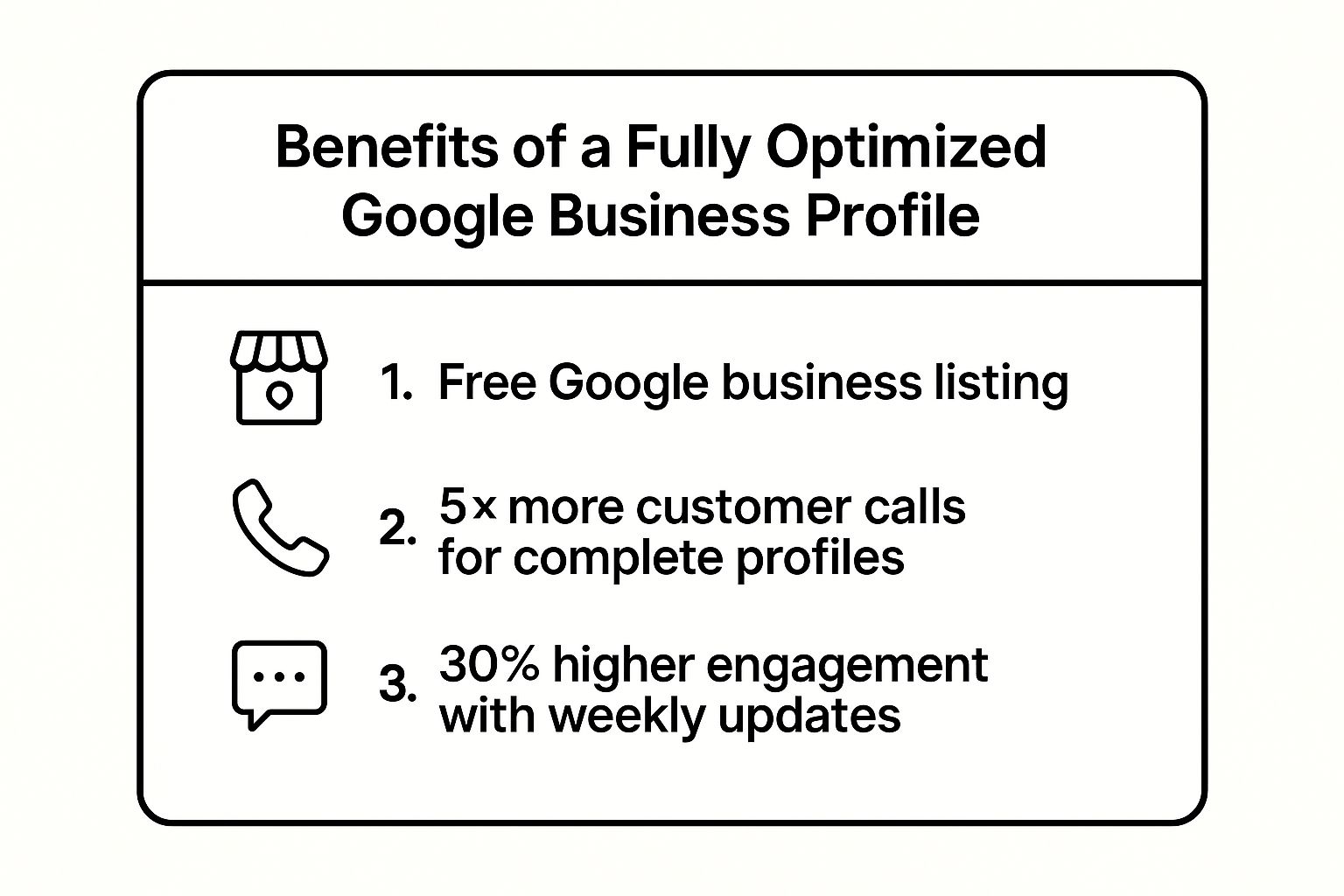
As the infographic highlights, a fully optimized GBP provides a free and highly visible listing on Google, leading to a significant increase in customer calls and overall engagement. These benefits are especially valuable for home service contractors seeking to connect with local customers actively searching for their services.
This video further explores the intricacies of GBP optimization, providing valuable insights from industry experts like Joy Hawkins and Mike Blumenthal. By implementing these strategies, home service contractors can leverage the power of local SEO to attract more customers, build brand awareness, and ultimately grow their businesses. Completing and optimizing your GBP is not just a task on a local SEO checklist; it's a fundamental investment in your business's online success.
2. Build and Maintain NAP Consistency
A critical element of any robust local SEO checklist is Name, Address, and Phone number (NAP) consistency. This involves ensuring your business information appears identically across all online platforms, directories, and citations. For home service contractors, consistent NAP information is essential for appearing in local search results when potential customers search for plumbers, electricians, or HVAC technicians in their area. Accurate NAP data builds trust with search engines and helps connect your business with local customers.

Why NAP Consistency Matters
Consistent NAP information signals to search engines that your business is legitimate and trustworthy, directly impacting local search rankings. Inconsistencies, even minor ones, can confuse search engines and dilute your online presence. This is especially true for home service contractors, where customers often rely on accurate location and contact information to find immediate assistance. Maintaining consistent NAP information ensures your business appears correctly in search results and online directories, making it easier for potential customers to find and contact you. Learn more about Build and Maintain NAP Consistency and discover essential aspects that can impact your local SEO success.
For example, McDonald's maintains identical NAP information across its 40,000+ locations worldwide, demonstrating the importance of consistency for large brands. A local law firm increased its local rankings by 40% after fixing NAP inconsistencies across 50+ directories, highlighting the direct impact on search visibility. Similarly, a multi-location retailer saw a 25% increase in store visits after a NAP standardization project, showcasing the connection between consistent NAP data and increased foot traffic.
Actionable Tips for NAP Consistency
- Create a Master NAP Document: Develop a single source of truth for your business information, referencing it for every online listing.
- Use NAP Audit Tools: Leverage tools like Moz Local or BrightLocal to identify and correct existing NAP inconsistencies across various directories.
- Standardize Abbreviations: Maintain uniformity by using consistent abbreviations for street (St.), suite (Ste.), and other address components.
- Website First: Update your NAP information on your website first, then replicate those changes across all other online platforms.
- Set up Google Alerts: Monitor mentions of your business name to catch new citations and ensure consistent NAP information from the outset.
Key Benefits of NAP Consistency
NAP consistency strengthens your local SEO, improves online visibility, and builds trust with both search engines and customers. This translates into higher search rankings, increased website traffic, and ultimately, more leads and customers for your home service business. For contractors seeking to dominate local search results, maintaining consistent NAP information isn't just a best practice; it's a necessity. This accuracy allows customers to easily find and contact you, whether they are searching on Google Maps, online directories, or social media platforms.
3. Actively Manage Online Reviews and Reputation
Online review management involves systematically encouraging positive reviews, professionally responding to all feedback, and maintaining a strong overall rating across platforms like Google, Yelp, and Facebook. For home service contractors, this is a non-negotiable aspect of a local SEO checklist. Reviews are a critical local ranking factor and heavily influence consumer purchasing decisions. In fact, 91% of consumers read online reviews before making a purchase decision, making them as important as word-of-mouth referrals.
Why Review Management Matters
Positive reviews build trust and credibility, showcasing your expertise and reliability to potential customers. They provide social proof, demonstrating that other homeowners have had positive experiences with your services. For home service contractors, this is particularly important as customers often rely on reviews to choose a reputable and trustworthy professional. Negative reviews, while undesirable, provide opportunities to address customer concerns and demonstrate your commitment to customer satisfaction.
For example, the Ritz-Carlton consistently maintains 4.5+ star ratings by responding to every review within 24 hours, showcasing their dedication to customer service. A local dentist office increased new patient bookings by 60% after implementing systematic review requests, demonstrating the direct impact of proactive review management. Even recovering from a crisis is possible through review management, as demonstrated by a restaurant chain that professionally addressed negative reviews, improved service, and regained customer trust.
Actionable Tips for Review Management
- Ask for Reviews: Request reviews immediately after positive customer interactions while the experience is fresh in their minds.
- Follow-Up Emails: Send follow-up emails 3-7 days after service completion with direct links to your review profiles on Google, Yelp, and other relevant platforms.
- Respond Promptly: Reply to all reviews within 24-48 hours, even if it's just a simple "thank you" for positive feedback. This shows engagement and responsiveness.
- Use Keywords: Naturally incorporate relevant keywords in your review responses to enhance SEO benefits. For example, a plumber might use terms like "drain cleaning" or "leak repair" when responding to relevant reviews.
- Negative Review Protocol: Create a protocol for handling negative reviews, ensuring a professional and courteous response. Address concerns directly and offer solutions to resolve the issue.
Key Benefits of Review Management
Proactive review management offers several key advantages:
- Improved Local SEO: Positive reviews boost your local search ranking, increasing visibility to potential customers.
- Increased Conversions: Positive reviews influence purchasing decisions, converting more leads into paying customers.
- Enhanced Trust & Credibility: Reviews provide social proof, building trust and establishing your reputation as a reliable contractor.
- Competitive Advantage: A strong online reputation sets you apart from competitors, particularly in competitive markets.
- Customer Insights: Reviews offer valuable feedback, highlighting areas for improvement and enhancing customer service.
Learn more about Actively Manage Online Reviews and Reputation
Actively managing online reviews and reputation is not just a checkbox on a local SEO checklist; it's an ongoing process that requires consistent effort. By implementing these strategies, home service contractors can leverage the power of online reviews to attract more customers, build a strong online reputation, and establish themselves as leaders in their local market. This proactive approach is an investment in long-term business growth and success.
4. Optimize Website for Local Keywords
Local keyword optimization involves researching and strategically incorporating location-based search terms throughout your website content, meta tags, and overall structure. This crucial step in any local SEO checklist ensures your website ranks higher in search results when potential customers search for services like "plumber near me," "electrician in [city name]", or "roof repair in [neighborhood]". For home service contractors, targeting these specific searches is essential for attracting local clients.
Why Local Keyword Optimization Matters
Imagine a homeowner in Denver searching for "emergency plumbing repair." If your website isn't optimized for "plumber Denver" or related keywords, you'll likely miss out on that potential customer. Local keyword optimization bridges the gap between online searches and your physical location, making it easier for local customers to find you. This is particularly important for home service businesses, where location plays a crucial role in customer decision-making.
For example, an HVAC company ranking #1 for "furnace repair Minneapolis" achieved this through dedicated service pages targeting specific locations and services. A law firm specializing in personal injury law saw a significant increase in leads after creating separate pages for each practice area combined with city names, such as "car accident lawyer Chicago." Similarly, a restaurant optimized for "Italian food downtown Seattle" and saw a 20% increase in online reservations.
Actionable Tips for Optimization
- Research Relevant Keywords: Utilize tools like Google Keyword Planner, SEMrush, and Ahrefs to identify local keywords your target audience uses. Pay attention to "near me" searches, city + service combinations, and neighborhood-specific terms. To further optimize your website for local keywords, consider exploring general SEO strategies.
- Optimize Title Tags and Meta Descriptions: Naturally incorporate city/region names and relevant keywords in your title tags and meta descriptions. This helps search engines understand your service areas and improves click-through rates from search results.
- Create Location-Specific Service Pages: If you serve multiple areas, create dedicated service pages for each location, highlighting the specific services you offer in that area. This helps target location-based searches more effectively.
- Use Local Landmarks and Neighborhoods: Incorporate familiar local landmarks and neighborhood names within your website content. This resonates with local customers and further reinforces your local presence.
- Monitor "Near Me" Search Performance: Track your website's performance for "near me" searches and optimize accordingly. This data provides valuable insights into how local customers are finding your business.
Key Benefits of Local Keyword Optimization
Optimizing your website for local keywords isn't just about ticking a box on your local SEO checklist; it's about connecting with your local community and driving tangible results. The benefits include:
- Increased Visibility in Local Search Results: Higher rankings for relevant local searches mean more potential customers will find your business online.
- Targeted Traffic and Lead Generation: Attract qualified leads actively seeking your services in your specific service areas.
- Improved Conversion Rates: Connect with customers who are ready to convert, as they've already expressed a need for your services in their local area.
- Enhanced Brand Authority: Establish your business as a local expert and build trust with your target audience.
- Sustainable Growth: A well-optimized website attracts consistent local traffic, leading to sustainable business growth.
By implementing these local keyword optimization strategies, home service contractors can effectively target their local market, attract more qualified leads, and ultimately grow their businesses. This is a fundamental step in any successful local SEO strategy.
5. Create Location-Specific Content and Landing Pages
A crucial element of any effective local SEO checklist, especially for home service contractors operating across multiple areas, is the creation of location-specific content and landing pages. Developing dedicated pages for each city or region you serve allows search engines to accurately understand your geographic relevance. This targeted approach also provides valuable, localized information to potential customers searching for services in their specific area. For a plumbing company servicing both Denver and Boulder, Colorado, separate landing pages tailored to each city are vital for attracting the right local customers.
Why Location Pages Matter
Location pages help avoid confusion for both search engines and users, ensuring that customers in a specific area find the most relevant information about your services. Imagine a roofing contractor serving the entire Dallas-Fort Worth metroplex. Without location-specific pages, a potential customer in Fort Worth might land on a page highlighting projects in Dallas, leading to a less personalized experience and a potential missed opportunity. Dedicated location pages signal to Google that you operate in a particular area, boosting your visibility in local search results. This is especially critical for home service contractors, as customers often search for immediate, local assistance.
For example, national chains like Home Depot effectively utilize location pages, providing store-specific details, local project ideas, and even area contractor recommendations. Similarly, a multi-location dental practice might create unique pages for each office, highlighting specific specialties and local community involvement. This tailored approach allows them to connect with potential patients on a more localized level. Learn more about location-specific content for home service contractors at Core6 Marketing's guide on website design and SEO.
Actionable Tips for Creating Location Pages
- Unique Content: Craft at least 300-500 words of original content for each location page, highlighting services, local team members, and area-specific project examples. Avoid duplicating content across multiple locations.
- Local Business Schema: Implement local business schema markup on each page, providing search engines with structured data about your business address, phone number, and operating hours for each location.
- Local Information: Include driving directions, parking information, and nearby landmarks to enhance convenience for local customers. Mentioning local events or community initiatives can further personalize the experience.
- Local Team and Services: Showcase local staff members, highlighting their expertise and community ties. Feature location-specific services or case studies relevant to the target area.
- Internal Linking: Link to and from your main service pages and location pages. This strengthens your overall website architecture and improves SEO.
Key Benefits of Location-Specific Pages
Location pages offer several significant advantages for home service contractors:
- Improved Local Search Visibility: Targeted pages increase your chances of ranking higher in local search results for specific cities or regions.
- Enhanced User Experience: Provide a more personalized and relevant experience for local customers, leading to higher engagement and conversion rates.
- Increased Credibility and Trust: Demonstrating a local presence builds trust and credibility with potential customers in each target area.
- Competitive Advantage: Outperform competitors who lack location-specific content, capturing more local leads and market share.
By creating dedicated location pages, home service contractors can significantly enhance their local SEO efforts, connect with more customers in their target areas, and ultimately drive business growth. This strategy is a valuable addition to any local SEO checklist.
6. Build Quality Local Citations and Directory Listings
Local citations are online mentions of your business name, address, and phone number (NAP) on directories, websites, and platforms. These mentions act as digital breadcrumbs, helping search engines understand your business's location and relevance to local searches. Building quality citations from authoritative local and industry-specific directories is a key component of any local SEO checklist for home service contractors. This process helps establish credibility with search engines and increases your online presence within your target service area.

Why Citation Building Matters
For home service contractors, accurate and consistent NAP information across multiple platforms is crucial. When potential customers search for "electrician near me" or "plumber in [city name]," search engines rely on citations to validate your business information and determine your local relevance. A strong citation profile can significantly improve your ranking in local search results, driving more visibility and leads. Quality, however, matters more than quantity in citation building. Focus on reputable directories and avoid spammy or low-quality sites.
For example, a local restaurant successfully listed on TripAdvisor, OpenTable, and city tourism websites sees a significant boost in online reservations. A professional service firm gaining citations from industry associations, local business journals, and chamber websites establishes greater credibility and attracts higher-value clients. Similarly, a home service contractor listed on HomeAdvisor, Angie's List, and local business directories experiences a noticeable increase in service calls.
Actionable Tips for Building Citations
- Prioritize Authoritative Directories: Start with essential directories like Yelp, Facebook, Apple Maps, and industry-specific platforms relevant to your trade (e.g., HomeAdvisor for contractors).
- Use Citation Building Tools: Moz Local and BrightLocal offer excellent tools for discovering citation opportunities and managing your online presence.
- Ensure NAP Consistency: Double-check that your business name, address, and phone number are identical across all listings. Even minor inconsistencies can confuse search engines and harm your rankings.
- Focus on Quality over Quantity: Avoid submitting your information to irrelevant or low-quality directories. This can be perceived as spam and negatively impact your SEO efforts.
- Track and Monitor: Regularly review your citations for accuracy and address any discrepancies promptly. Tools like BrightLocal can automate this process and alert you to any issues.
Key Benefits of Local Citations
Building quality citations isn't just a checkbox on a local SEO checklist; it's a strategic investment in your online visibility. Accurate and consistent citations:
- Boost Local Search Rankings: Strong citation profiles help search engines recognize your business as relevant to local searches, improving your ranking in local search results.
- Increase Online Visibility: Citations on popular platforms expose your business to a wider audience, driving more traffic to your website and generating leads.
- Build Trust and Credibility: Being listed on reputable directories and platforms enhances your business's credibility and trustworthiness in the eyes of potential customers.
- Drive More Traffic and Leads: Increased visibility translates into more website traffic, phone calls, and ultimately, more business.
By strategically building quality local citations, home service contractors can significantly enhance their online presence and attract more customers in their service area. This is a crucial step in any local SEO strategy, particularly for businesses reliant on local search visibility.
7. Implement Local Business Schema Markup
A crucial element of any effective local SEO checklist is the implementation of local business schema markup. Schema markup is essentially structured data code that you add to your website's HTML. This code helps search engines like Google understand your business information more clearly and display it more effectively in search results. For home service contractors, this can translate to richer search snippets, improved visibility, and ultimately, more leads. Think of schema markup as giving Google a cheat sheet about your business, enabling it to present your key information prominently in local search results.
Why Schema Markup Matters
Schema markup provides context to your website's content, allowing search engines to understand the type of information presented on your pages. This enhanced understanding helps Google categorize your business correctly and present it to relevant searchers. For example, without schema, Google might recognize that your website mentions "plumbing," but with schema, it can definitively identify you as a "Plumbing Contractor." This precision is essential for appearing in local searches for plumbing services. Imagine a homeowner searching for "emergency plumber near me." Schema helps ensure your business appears at the top of the results if you offer emergency plumbing services in that area.
Restaurant chains often leverage schema to showcase their hours, ratings, and price range directly in search results. Medical practices use schema to highlight specialties, accepted insurance, and appointment booking options. Similarly, home service contractors can utilize schema to display service areas, emergency availability, and customer reviews, giving potential clients a comprehensive overview at a glance. A study by Searchmetrics found that websites using schema markup rank an average of four positions higher in search results, highlighting its significant impact on local SEO performance.
Actionable Tips for Implementation
- Use Google's Structured Data Testing Tool: This free tool allows you to test and validate your schema markup, ensuring it's correctly implemented and free of errors.
- Start with LocalBusiness Schema: Begin with the basic LocalBusiness schema type and gradually add more specific variations as needed. This provides a solid foundation and minimizes complexity.
- Include Comprehensive Information: Add as much relevant information as possible, such as your business name, address, phone number, hours of operation, payment methods, and service areas. The more data you provide, the richer your search snippets become.
- Update Regularly: Keep your schema markup up-to-date with any changes to your business information. Inconsistent information can confuse search engines and negatively impact your local SEO.
- Consider Professional Assistance: If you're not comfortable working with code, consider hiring a developer or SEO specialist to implement and manage your schema markup.
Key Benefits of Schema Markup
Schema markup enhances your visibility in local search results by providing detailed information to search engines. This increased visibility can lead to higher click-through rates, improved rankings, and ultimately, more customers for home service contractors. By providing context and clarity to your website's content, schema markup helps you connect with the right customers at the right time. Implementing local business schema markup is not merely a checkbox on a local SEO checklist; it’s a strategic move to amplify your online presence and attract more local business.
Local SEO Checklist Comparison Guide
| Strategy | Implementation Complexity 🔄 | Resource Requirements ⚡ | Expected Outcomes 📊 | Ideal Use Cases 💡 | Key Advantages ⭐ |
|---|---|---|---|---|---|
| Complete and Optimize Google Business Profile | Medium – requires setup and ongoing updates | Low – free platform, some time investment | Increased local visibility, 5× more calls, higher engagement | All local businesses aiming for local search prominence | Free to use, direct impact on search, customer insights |
| Build and Maintain NAP Consistency | Medium to High – auditing and maintaining many platforms | Moderate – monitoring tools and time | Improved local rankings, trust, reduced customer confusion | Multi-location businesses, entities with many listings | Boosts SEO rankings, brand consistency, trust building |
| Actively Manage Online Reviews and Reputation | High – constant monitoring and responses | High – time-intensive and platform vigilance | Better local rankings, higher conversion, enhanced trust | Service businesses reliant on reputation (restaurants, healthcare) | Direct influence on SEO and customer trust, feedback insights |
| Optimize Website for Local Keywords | Medium – ongoing keyword research and content updates | Moderate – SEO tools and content resources | Higher rankings for local queries, increased qualified leads | Businesses targeting location-specific searches | Captures local search intent, supports other SEO efforts |
| Create Location-Specific Content and Landing Pages | High – requires content creation for each location | High – content production and maintenance | Improved local rankings, better UX, multi-market targeting | Multi-location businesses with distinct service areas | Builds local authority, enhances user experience, SEO benefits |
| Build Quality Local Citations and Directory Listings | Medium – submission and monitoring process | Moderate – research, submissions, tracking | Enhanced local rankings and visibility, increased traffic | Businesses needing broad local presence and authority | Improves visibility, builds backlinks, builds credibility |
| Implement Local Business Schema Markup | High – requires technical knowledge or developer | Moderate to High – technical resources | Enhanced SERP appearances, better understanding by search engines | Businesses wanting rich snippets and advanced SEO features | Better CTR, competitive edge, voice search support |
Final Thoughts
This local SEO checklist has provided a roadmap for home service contractors to enhance their online visibility and attract more local customers. We've covered essential elements, from optimizing your Google Business Profile and managing online reviews to leveraging local keywords and schema markup. By consistently applying these strategies, you can establish a strong online presence and dominate your local market.
The Power of a Localized Approach
Remember, the core of local SEO is relevance and proximity. You're aiming to appear as the top choice for customers searching for services like yours within their specific geographic area. Whether it's "emergency plumber in [city name]" or "best HVAC repair near me," your optimized presence needs to resonate with these localized searches. This approach builds trust and credibility, positioning your business as the go-to solution for local homeowners.
Key Takeaways for Lasting Success
Let's recap the most crucial aspects of this local SEO checklist:
- Google Business Profile (GBP): A complete and accurate GBP is your digital storefront. Keep it updated with current information, high-quality photos, and engaging posts to attract and inform potential customers.
- NAP Consistency: Maintaining consistent Name, Address, and Phone Number (NAP) information across all online platforms builds credibility and helps search engines verify your business legitimacy.
- Online Reviews: Actively solicit and manage online reviews. Positive reviews act as powerful social proof, influencing customer decisions and boosting your search ranking.
- Local Keyword Optimization: Integrate relevant local keywords into your website content, meta descriptions, and title tags to signal relevance to search engines and potential customers.
- Location-Specific Content: Creating dedicated landing pages and content targeting specific service areas helps you rank higher for local searches and cater to a hyper-local audience.
- Local Citations: Building high-quality local citations and directory listings further establishes your business presence and authority within your service area.
- Schema Markup: Implementing local business schema markup helps search engines understand your business information, leading to richer search results and improved click-through rates.
Taking the Next Steps
Mastering these concepts isn't a one-time effort, but an ongoing process of optimization and refinement. Regularly analyze your website traffic, track your keyword rankings, and monitor your online reputation to identify areas for improvement. Stay adaptable and embrace new technologies and strategies as the digital landscape evolves. The rewards of a well-executed local SEO strategy are substantial – increased visibility, higher lead generation, and ultimately, business growth. By prioritizing these tactics, you're investing in the long-term success of your home service contracting business.
Dominating the local search results puts you ahead of the competition. It allows you to capture the attention of homeowners actively seeking your services at the precise moment they need them. This translates into more qualified leads, increased conversions, and a stronger bottom line.
Ready to take your local SEO to the next level? Core6 Marketing specializes in helping home service contractors like you dominate local search rankings. We handle everything from website optimization and GBP management to review generation and citation building. Visit Core6 Marketing today to discover how we can transform your online presence and drive more local business.