Direct Answer: Most contractor Google Ads campaigns waste money because of broad match keywords, traffic sent to generic homepages, and missed calls — not because Google Ads doesn’t work for contractors.
A lot of contractors on the Central Coast have tried Google Ads and quit. The story usually goes the same way: they ran a campaign for a few months, spent a few thousand dollars, and couldn’t tell you whether it brought in a single job. So they decided the platform doesn’t work and went back to word of mouth.
But the platform isn’t usually the problem. In most cases, the campaign was built wrong from day one — and nobody ever explained why.
There are three specific places where contractor Google Ads campaigns fall apart. And if you’ve been burned before, at least one of them will sound familiar.
The Real Problem: What Your Ads Are Actually Targeting
Most contractors who set up Google Ads — or had an agency do it on the cheap — end up running broad match keywords. That sounds technical, but the consequence is simple: your ads show up for searches that have nothing to do with hiring you.
A plumber in Salinas running ‘plumbing services’ on broad match can end up paying for a click from someone in Santa Cruz searching ‘how to fix a leaky faucet.’ That’s a real scenario, not a hypothetical. Google’s algorithm, left unchecked, will match your keyword to almost anything it considers loosely related.
The fix is keyword match types — specifically, switching to phrase match or exact match and building a tight negative keyword list that blocks searches like:
- ‘DIY’
- ‘how to’
- ‘free estimate template’
- ‘plumbing school near me’
- Job titles and competitor brand names
On the Monterey Bay Area, where your service area might cover Seaside, Marina, and Carmel but definitely not San Jose or Fresno, geographic targeting compounds the problem. A campaign without proper city-level radius settings bleeds budget outside the zip codes you actually serve. The match type is the campaign — and most contractors never touch it.
For a deeper look at what contractors are actually paying per click on the Central Coast, what contractors actually pay for Google Ads breaks down the cost factors in plain terms.

What It Actually Costs Per Lead — and Why the Monterey Area Is Different
Cost-per-lead numbers have been climbing. A 2025 analysis of over 3,200 U.S. home service search campaigns puts the average cost per lead at roughly $45 for HVAC, $52 for plumbing, and $79 for roofing — and about 70% of advertisers saw those numbers rise year-over-year.
Those are national averages. On the Central Coast, the math can look different — sometimes better, sometimes worse — depending on one key factor: how precisely the campaign targets cities.
A roofing contractor in Monterey County targeting a tight radius around Monterey, Pacific Grove, and Carmel is competing in a smaller auction pool than a contractor running county-wide. That can mean lower cost-per-click when done right. But if the same campaign is left on default geographic settings, it may be competing against contractors from the Salinas Valley all the way down to King City who have no intention of driving to the Peninsula.
The Central Coast’s geography is actually an advantage — but only if the campaign is built to use it.
Estimated Average Cost Per Lead by Trade — Home Service Google Ads (2025)
These figures come from a 2025 analysis of U.S. home service search campaigns. Actual costs on the Central Coast will vary based on competition, targeting precision, and landing page quality.
| Trade | Avg. Cost Per Lead (National) | Key Variable on Central Coast |
|---|---|---|
| HVAC | ~$45 | Seasonal demand swings in Salinas Valley vs. Monterey Peninsula |
| Plumbing | ~$52 | City-level targeting vs. broad county targeting |
| Roofing | ~$79 | Higher ticket = higher competition; Peninsula market is smaller but concentrated |
| General Contractor | Varies widely | Project type and scope filter matters more than geography alone |
| Pest Control | Lower end of range | High search volume in Watsonville and Salinas agricultural corridor |
The Landing Page Problem Nobody Talks About
Even a well-targeted campaign fails if the click goes nowhere useful. And most contractor campaigns send traffic to the homepage.
A homepage is built to introduce your business. It talks about your history, your services in general, maybe your service area. It is not built to make someone pick up the phone and call right now.
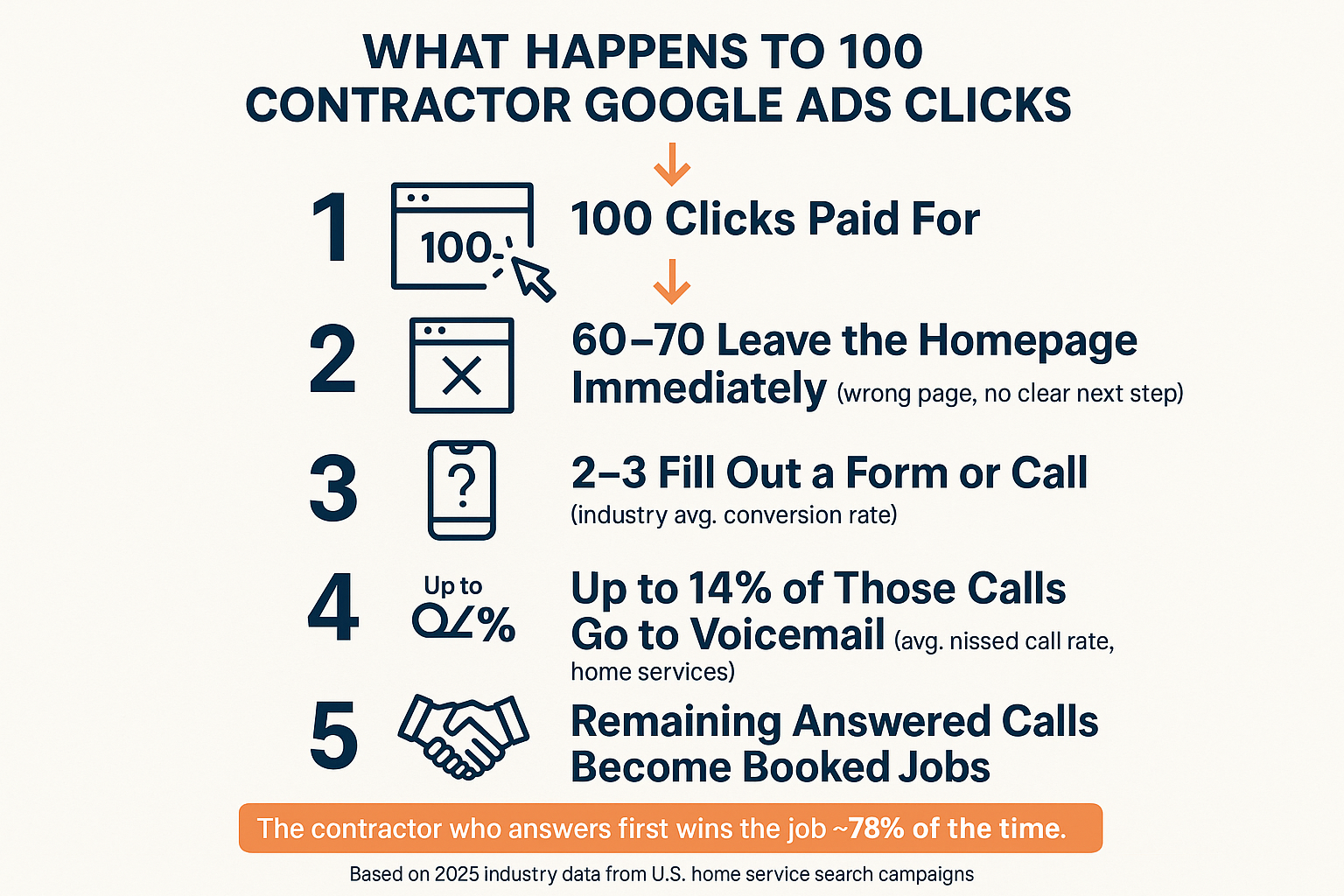
Industry data consistently shows that contractor websites convert only 2–3% of visitors into a form submission on average. That means 97 out of 100 people who click your ad leave without doing anything. And you paid for all 100 clicks.
A conversion-focused landing page for an HVAC or plumbing contractor on the Monterey Bay Area looks different from a homepage. The key elements:
- A headline that matches the search (e.g., ‘AC Repair in Monterey — Same-Day Service Available’)
- One clear offer above the fold — not five links to other pages
- A phone number in large text, clickable on mobile
- 3–5 specific trust signals: license number, years in business, service area cities, one or two short customer quotes
- No navigation menu — you don’t want them clicking away
Sending paid traffic to a generic homepage is the same mistake as buying a billboard and putting your logo on it with no phone number. The ad spend and the website quality are the same problem.
If you want to understand why even a well-ranked site can fail to generate calls, why most contractor websites rank but don’t ring covers that gap in detail.
What Happens to 100 Contractor Ad Clicks
This breakdown shows where paid traffic typically drops off before it becomes a booked job — and where the fixable losses happen.
The Step Most Contractors Skip Entirely: What Happens When the Phone Rings
Here’s where ad spend becomes invisible waste: a campaign generates 30 qualified leads a month, and 9 of them go to voicemail.
Research puts the average missed call rate in home services at around 14%. And data shows that the contractor who responds first wins the job roughly 78% of the time. If a homeowner in Seaside is searching for an electrician on a Tuesday afternoon and the first three contractors they call all go to voicemail, the one who calls back in under five minutes gets the job — regardless of price.
This is not a marketing problem. It’s an operations problem that marketing spending makes visible. You can run a technically clean campaign, get the match types right, send traffic to a dedicated landing page, and still lose half the jobs if the phone isn’t covered.
Tracking which calls are coming from your ads — and whether they’re being answered — is the part most contractors never audit. If you’re spending $1,500 a month on ads and missing 4 calls a week, the real cost-per-acquired-job may be double what the dashboard shows.
For a broader look at the call-handling side of lead generation and how PPC campaign optimization connects to real booked revenue, that’s a useful companion read.
Frequently Asked Questions About Google Ads for Contractors
Can Google Ads actually work for a small contractor in Salinas or Monterey?
Yes, but the campaign has to be built for a tight local market. A one-person plumbing company in Salinas does not need to compete across all of Monterey County — they need to dominate a 10–15 mile radius with the right keywords and a landing page that converts. Small service areas can actually be an advantage because you’re competing against fewer bidders in the auction.
How long does it take to see results from Google Ads?
Unlike SEO, Google Ads can generate calls within the first week a campaign goes live. The first 30–60 days are typically a learning period where you’re identifying which keywords and ads are producing leads and cutting the ones that aren’t. A well-managed campaign usually shows reliable cost-per-lead data by the end of month two.
What’s the difference between Google Ads and Local Service Ads?
Google Ads (search campaigns) run on keywords you choose and charge per click. Local Service Ads (LSAs) appear above traditional ads, show a ‘Google Guaranteed’ badge, and charge per lead rather than per click. Many contractors benefit from running both — LSAs for the top-of-page trust signal and search campaigns for more control over which searches trigger your ad.
How much should a contractor budget for Google Ads on the Central Coast?
There’s no universal number, but the budget has to be large enough to generate enough data to optimize. For trades like plumbing or HVAC in Monterey County, running on less than $800–$1,000/month often means too few clicks per week to know what’s working. The what contractors actually pay for Google Ads article breaks down the cost factors in more detail.
Should I pause my Google Ads campaign if my schedule is already full?
Pausing makes sense when you physically can’t take on more work — but do it deliberately, not by letting the budget run dry. A campaign that gets paused and restarted repeatedly loses the optimization data Google’s algorithm builds over time. A better option is to lower the daily budget rather than stop entirely, so the campaign stays active at a lower volume.
Does having a bad website hurt my Google Ads performance?
Directly, yes. Google’s Quality Score — which affects what you pay per click — factors in the relevance and quality of your landing page. A slow, generic homepage will raise your cost-per-click compared to a fast, relevant landing page. And beyond the Quality Score, a weak page simply won’t convert the traffic you’re paying for. The ad and the page are one system, not two separate decisions.
Want to Know If Your Google Ads Budget Is Working?
Core6 Marketing works exclusively with home service contractors on the Central Coast — Salinas, Monterey, Seaside, Marina, Carmel, and the surrounding area. If you’ve run Google Ads before and couldn’t tell whether they actually drove jobs, or you’re thinking about starting and want to know what a well-built campaign looks like, Phil Fisk offers a straight-talk Discovery Call with no sales pitch attached. Book a time at https://calendly.com/core6-marketing/30min.